
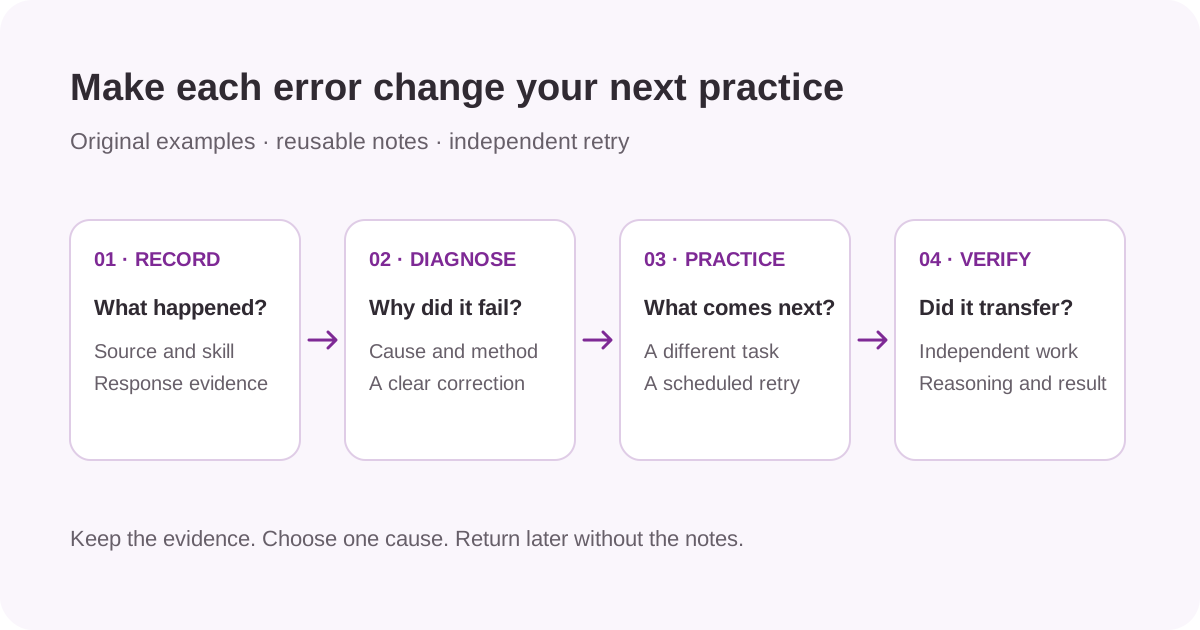
Key takeaways
- This log is for PSAT/NMSQT. Record module and practice source, but do not infer an adaptive route, selection index or scholarship outcome from an error count.
- Compare the reasoning used on an item with the evidence or mathematical relationship it required.
- Use a fresh task or response for verification; remembering a reviewed answer is not enough.
- The five examples are fictional and do not reproduce official exam questions.
Use the log for PSAT/NMSQT reasoning
A PSAT/NMSQT error log turns a practice result into an observable learning task. It is not a way to reconstruct your score or predict National Merit outcomes. This guide focuses on the digital PSAT/NMSQT, with Reading and Writing and Math organized into modules. Record the exact assessment and source you used. PSAT 8/9 and PSAT 10 have their own context; avoid silently merging their results into a PSAT/NMSQT record.
On an adaptive assessment, a count of missed questions does not reveal a scoring formula or the difficulty of every item you received. Your log should preserve what you can actually observe: the question reference, your reasoning, the explanation and the later check. Include correct guesses and answers you could not justify, since they identify uncertainty that a total-correct count can miss.
Choose useful columns rather than more columns
Write the date and source reference so you can find an explanation again without copying the full question. Add the section, module when known, and skill shown by the item. For Reading and Writing, preserve the textual evidence or relationship between ideas. For Math, write the expression, model or condition that caused trouble. The correction should describe a reasoning action, not just repeat the correct option.
A student who confuses slope and intercept needs to interpret quantities and units; a student who makes an arithmetic slip after a sound setup needs a different check. Keeping these causes separate prevents unnecessary review of an entire algebra topic. A tutor can use the same columns to ask the student to explain the original decision before assigning more practice.
Diagnose the attractive answer
In a short passage, a distractor may share the topic while overstating the author's claim. Record the qualifying word that limits the claim, then explain why your answer exceeded it. For transition questions, label the relationship between ideas before examining options: an example, contrast or consequence requires different reasoning. Boundary questions need clause structure, not a guess based on where a pause sounds natural.
Math verification should return to the original relationship. If manipulation creates a candidate that violates a restriction, the lesson is to check the candidate, not to memorize that one answer. If you used a calculator or graph, explain what the output represents and whether it fits the context. A tool result is evidence to interpret, not a substitute for the interpretation.
Five fictional PSAT/NMSQT log entries
These examples are original teaching scenarios, not reproduced College Board items. They show how two students could miss questions on the same topic for different reasons. Your own entry should reference the official practice item and use its explanation. Leave the verification result open until you attempt a fresh item; recognizing yesterday's answer is weaker evidence than independently applying a correction to a new situation.
| Skill/task | Observed problem | Cause | Correction | Next practice | Later verification |
|---|---|---|---|---|---|
| Reading and Writing: evidence | Chose an answer that overstated a study result. | Missed a limiting word in the text. | Underline qualifiers before testing each answer against the claim. | Compare three brief claims with their evidence. | Explain the qualifier on a fresh practice item. |
| Reading and Writing: transitions | Picked a contrast word for an example. | Looked at one sentence rather than the relationship between ideas. | Label the relationship before considering transition options. | Write the relationship for four short sentence pairs. | Choose and justify a transition later without options first. |
| Reading and Writing: boundaries | Separated a dependent clause as a complete sentence. | Did not locate the main subject and verb. | Mark clause roles before deciding on a boundary. | Check a small set of clause-boundary questions. | Explain a new dependent clause and its main clause. |
| Math: linear model | Read the intercept as the rate of change. | Did not attach meaning and units to equation terms. | Describe slope and intercept in the situation before solving. | Interpret three new linear models. | Write units and meanings on a later model. |
| Math: checking a solution | Entered a root that failed a restriction in the original expression. | Stopped after manipulating the equation. | Substitute candidates into the original relationship and restrictions. | Solve two new equations and check every candidate. | Verify a later candidate before submitting it. |
Review patterns without inventing a score forecast
During a weekly review, group rows by the action that failed: checking qualifiers, identifying relationships, recognizing clauses, interpreting models or validating solutions. Select one pattern and explain the correction from memory. Practice a small new set from an appropriate official resource, then check it again later under conditions you record. Mark whether you could explain the method as well as answer. If the issue returns, reopen it rather than deleting its history. Use official score reports for scores and scholarship-related information; this routine helps organize practice and makes no scholarship or score guarantee.
Official resources and the next step
Check current format details with PSAT/NMSQT structure. Use the other official sources listed with this guide for legitimate practice and criteria. Access conditions may vary, and some preparation products require payment or an account. This independent guide is not endorsed by the exam owner.
Start with the PSAT/NMSQT error log template. Fill one row from your own attempt, choose one concrete correction and schedule a fresh verification. Keep personal identifiers and complete copyrighted questions out of shared copies. Your log should make the next learning decision clearer, not promise an outcome.
Sources and methodology
AI-assisted original English editorial draft prepared in Codex on 2026-10-05. Official exam-provider pages were checked for current format and preparation guidance. The examples are fictional original learning scenarios, not copied test questions or official scored responses. The weekly review loop is a practical editorial suggestion, not a claim that a particular cadence is optimal. This guide offers no score, passing, scholarship or admissions guarantee. Human editorial review was approved by Maksim Mamchur on 2026-10-05.


