
Key takeaways
- Keep the four MCAT sections distinct. For CARS, justify answers from the passage rather than outside science knowledge. This is a study aid, not a score predictor or medical advice.
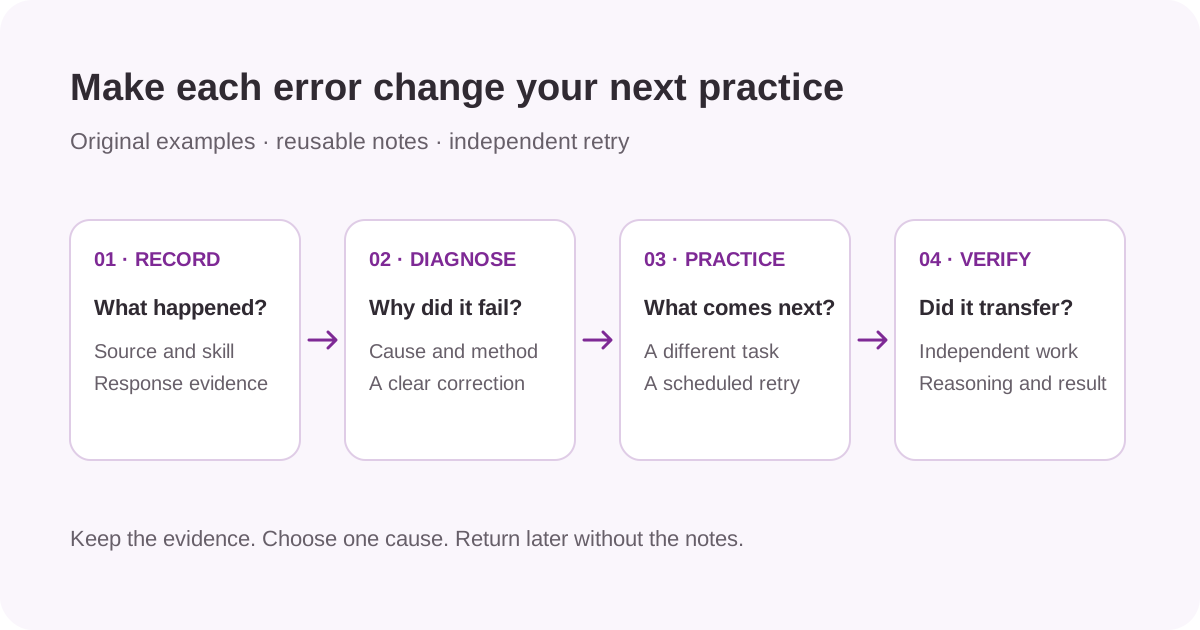
- Name both the content concept and the reasoning action; repair the one the evidence shows was missing.
- Use a fresh task or response for verification; remembering a reviewed answer is not enough.
- The five examples are fictional and do not reproduce official exam questions.
Separate content from reasoning on the MCAT
The MCAT has four sections: Biological and Biochemical Foundations of Living Systems; Chemical and Physical Foundations of Biological Systems; Psychological, Social, and Biological Foundations of Behavior; and Critical Analysis and Reasoning Skills, or CARS. A useful error log keeps the section explicit and separates the concept you needed from the reasoning you had to perform. Knowing a pathway does not guarantee that you interpreted an experiment using that pathway correctly.
Start each row with the legitimate practice source, passage or item reference. Identify the content concept when applicable and the action that failed: interpreting a figure, relating variables, evaluating a study design or following a passage argument. This makes the next assignment more specific than “review biology” or “practice more CARS.” Include correct guesses you could not justify.
Use the passage and figure as evidence
For science passages, state the manipulated condition, measured outcome and comparison before applying remembered content. Read axes, captions and normalization carefully. A plotted difference can mean something different after you notice the baseline or units. When a quantitative relationship is involved, retain the setup and check scale as well as arithmetic. A numerically neat answer can still be based on incompatible quantities.
For behavioral or social studies, distinguish an association from evidence supporting causation and name relevant design limits. For CARS, justify an inference through the author's wording, purpose and argument. Outside science knowledge can make an answer sound plausible while taking you beyond the passage. Keep that cause separate from unfamiliar vocabulary or difficulty identifying paragraph roles.
Choose the repair indicated by your work
A content gap calls for a focused explanation and a check that you can recall and use the concept. A reasoning gap calls for new material requiring the missing action. Annotating experimental variables or describing a figure comparison can be useful even before you answer another question. If both concept and reasoning were weak, record them as separate tasks instead of assuming one will fix the other.
Write a correction you can apply without rereading yesterday's solution. “Check axes and normalization before comparing groups” is actionable; “read carefully” is not precise enough to test. Preserve your own explanation and a source reference rather than reproducing entire copyrighted passages. Ask an instructor about uncertain scientific interpretations rather than treating an AI-generated explanation as authoritative.
Five fictional MCAT log entries
These examples are invented observations, not AAMC items, official explanations or measured score outcomes. One science-figure row crosses content areas intentionally: interpretation skills can matter in several sections, but your actual entry should still name its section. Verification should demonstrate the correction on an unfamiliar passage, experiment or calculation. For CARS, it should include passage support rather than added outside facts.
| Skill/task | Observed problem | Cause | Correction | Next practice | Later verification |
|---|---|---|---|---|---|
| Biological and Biochemical Foundations: experiment | Predicted a result without checking the manipulated condition. | Used a memorized pathway but ignored the experimental setup. | Map manipulation, measured outcome and expected direction together. | Explain two new intervention-and-outcome relationships. | Predict a fresh result and cite the experimental condition. |
| Chemical and Physical Foundations: units | Combined quantities with incompatible units. | Started algebra before a unit and scale check. | Track units and order of magnitude through the relationship. | Set up three new calculations with explicit units. | Audit a later result for units and plausible scale. |
| Psychological, Social and Biological Foundations: study design | Inferred causation from an observed association. | Ignored how participants and variables were studied. | Identify design and plausible alternative explanations. | Compare observational and experimental scenarios. | Qualify a conclusion for an unfamiliar study. |
| CARS: inference | Used outside knowledge to choose an unsupported answer. | Let a familiar topic override the author's argument. | Tie the inference to passage wording and paragraph purpose. | Compare two inferences against a fresh short passage. | Explain support without adding outside facts. |
| Science passage: figure interpretation | Read a plotted difference without noticing the normalization. | Skipped the figure caption and axis definition. | Describe axes, baseline and comparison before interpreting. | Annotate two new figures and state the comparison. | Interpret a fresh figure with its caption included. |
Review one recurring cause each week
Group the week's rows into content learning, experimental reasoning, quantitative setup, study-design interpretation and passage evidence. Select a repeated cause, explain the correction from memory and complete a small new task requiring it. Return later to a fresh example and record what you could justify independently. Keep uncertain rows open and use official AAMC preparation to contextualize results. This is a study-planning suggestion, not medical advice, a score prediction or proof that a particular review interval is optimal. It cannot replace official testing policies, readiness judgment or instruction.
Official resources and the next step
Check current format details with About the MCAT Exam. Use the other official sources listed with this guide for legitimate practice and criteria. Access conditions may vary, and some preparation products require payment or an account. This independent guide is not endorsed by the exam owner.
Start with the MCAT error log template. Fill one row from your own attempt, choose one concrete correction and schedule a fresh verification. Keep personal identifiers and complete copyrighted questions out of shared copies. Your log should make the next learning decision clearer, not promise an outcome.
Sources and methodology
AI-assisted original English editorial draft prepared in Codex on 2026-10-05. Official exam-provider pages were checked for current format and preparation guidance. The examples are fictional original learning scenarios, not copied test questions or official scored responses. The weekly review loop is a practical editorial suggestion, not a claim that a particular cadence is optimal. This guide offers no score, passing, scholarship or admissions guarantee. Human editorial review was approved by Maksim Mamchur on 2026-10-05.


