
Key takeaways
- Since August 2024 the multiple-choice LSAT has scored Logical Reasoning and Reading Comprehension, with an additional unscored section. Logic Games is not a current section; Argumentative Writing is separate.
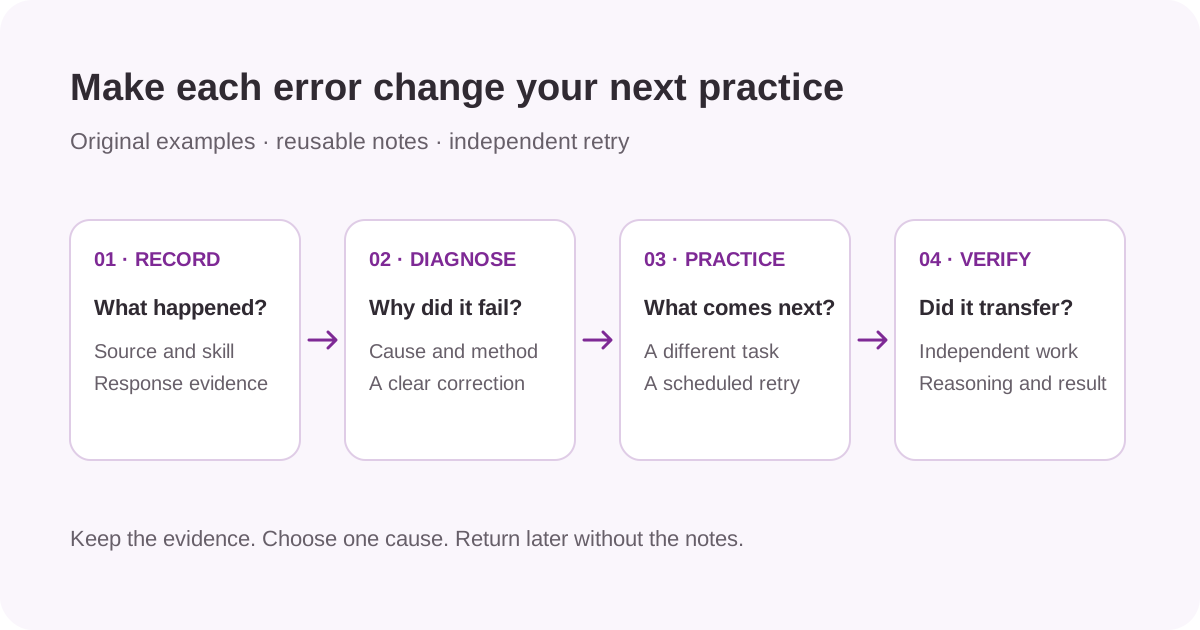
- Record the logical step or passage evidence that made a distractor attractive, then test a new argument.
- Use a fresh task or response for verification; remembering a reviewed answer is not enough.
- The five examples are fictional and do not reproduce official exam questions.
Prepare for the LSAT that exists now
A current LSAT error log focuses on Logical Reasoning and Reading Comprehension. Since August 2024, the multiple-choice test has two scored Logical Reasoning sections, one scored Reading Comprehension section and an additional unscored section. Logic Games, also called Analytical Reasoning, is not a current section. LSAT Argumentative Writing is separate. Do not let a familiar older study spreadsheet quietly define your preparation for a different format.
Record a LawHub test, section and item reference along with the task the question asks you to perform. Avoid copying complete official items into a public or shared log. A short description of your reasoning and a reliable reference give you enough to return to the original explanation while respecting the source material.
Make the reasoning error explicit
In Logical Reasoning, identify premises and conclusion before naming a flaw or assumption. A necessary assumption is not merely an idea that helps an argument. A conditional statement does not automatically support its converse. A flaw label matters only if you can connect it to the argument's specific leap. Your row should preserve that connection in plain language rather than collecting terminology without application.
In Reading Comprehension, record the passage evidence and the scope of the claim you accepted. If you inferred an author's strong approval from neutral wording, name the words that actually support the degree of attitude. Comparative passages need separate claim maps: a view belonging to passage A cannot be attributed to both authors unless the texts justify that comparison.
Separate blind review from later transfer
If you reattempt an item before looking at the answer, record that condition. It can help distinguish uncertainty under time pressure from a reasoning gap. After reading an explanation, reconstruct the argument yourself and state why the attractive distractor fails. Recognizing an explanation is easier than producing one. Mark disagreements or unclear points for instruction rather than confidently rewriting them as your own rule.
Then choose new material that requires the same action. Conditional translation practice should use new claims; an attitude problem should lead to text-evidence checks on a different passage. If you also prepare for Argumentative Writing, use a separate response record for the position, supporting reasons and engagement with other perspectives. Do not score writing through multiple-choice accuracy or pretend that it has an answer key.
Five fictional LSAT log entries
The table contains original learning scenarios, not LSAC questions or official explanations. It omits Logic Games because those are not part of the current test. Each row identifies a reasoning action that can be checked on a different argument or passage. Your own log should retain uncertainty until you can explain the correction independently; merely remembering which option you previously missed does not establish transfer.
| Skill/task | Observed problem | Cause | Correction | Next practice | Later verification |
|---|---|---|---|---|---|
| Logical Reasoning: necessary assumption | Picked a helpful statement that the argument did not require. | Confused strengthening with necessity. | Ask whether denying the candidate undermines the stated reasoning. | Compare necessary and merely helpful assumptions on new arguments. | Explain necessity for a fresh candidate. |
| Logical Reasoning: conditional reasoning | Reversed the direction of an if-then statement. | Treated a sufficient condition as a necessary one. | Write the stated implication and a valid contrapositive. | Translate three new conditional claims. | Check a later inference against the original direction. |
| Logical Reasoning: flaw | Named a flaw unrelated to the actual conclusion. | Matched a familiar label before mapping the argument. | State the leap from premises to conclusion in plain language. | Describe flaws in two unfamiliar short arguments. | Explain the specific leap before selecting an answer. |
| Reading Comprehension: author attitude | Inferred strong approval from a neutral description. | Used the topic rather than tone and qualification as evidence. | Locate wording that supports the degree of attitude. | Compare two attitude descriptions with text support. | Cite tone evidence in a new passage. |
| Reading Comprehension: comparative passage | Attributed one author's view to both passages. | Failed to track separate claims and points of agreement. | Keep an A/B claim map and mark shared versus distinct positions. | Map a fresh pair before answering. | Verify a later comparison with evidence from both passages. |
Review by recurring reasoning action
In a weekly review, group rows by necessity, conditional direction, argumentative leap, tone evidence or comparison of claims. Pick one repeated cause and explain the correction without consulting the old item. Attempt a few new legitimate practice questions, then return later to an unfamiliar argument or passage. Record the evidence for the decision and whether you needed assistance. Use current LawHub materials and official LSAC guidance for test information. This cadence is an editorial study suggestion, not a guarantee of a higher LSAT score or a claim that one interval suits every learner.
Official resources and the next step
Check current format details with LSAT current format FAQs. Use the other official sources listed with this guide for legitimate practice and criteria. Access conditions may vary, and some preparation products require payment or an account. This independent guide is not endorsed by the exam owner.
Start with the LSAT error log template. Fill one row from your own attempt, choose one concrete correction and schedule a fresh verification. Keep personal identifiers and complete copyrighted questions out of shared copies. Your log should make the next learning decision clearer, not promise an outcome.
Sources and methodology
AI-assisted original English editorial draft prepared in Codex on 2026-10-05. Official exam-provider pages were checked for current format and preparation guidance. The examples are fictional original learning scenarios, not copied test questions or official scored responses. The weekly review loop is a practical editorial suggestion, not a claim that a particular cadence is optimal. This guide offers no score, passing, scholarship or admissions guarantee. Human editorial review was approved by Maksim Mamchur on 2026-10-05.


