
Key takeaways
- Use the current shorter GRE General Test. Analytical Writing contains Analyze an Issue; do not add the retired Analyze an Argument task to a current-test log.
- Check evidence, constraints and answer format before assuming a miss needs more content memorization.
- Use a fresh task or response for verification; remembering a reviewed answer is not enough.
- The five examples are fictional and do not reproduce official exam questions.
Log the current GRE General Test
A GRE error log should distinguish Verbal Reasoning, Quantitative Reasoning and Analytical Writing rather than combining them into one collection of wrong answers. Use the current shorter GRE General Test format. Analytical Writing now uses Analyze an Issue; an old Analyze an Argument task belongs to older preparation material and should not be labeled as a current test requirement.
Record the practice source and question or task type before naming a weakness. A text-completion miss may come from vocabulary, sentence logic or both. A quantitative comparison miss may come from unstated assumptions rather than algebra. A writing response may need clearer development even when its position is easy to understand. Your diagnosis determines what you should practice next.
Preserve the decision, not only the answer
For Verbal questions, describe why an option seemed attractive and what sentence or passage evidence should have ruled it out. Predicting the needed meaning before viewing text-completion options can expose whether the issue was logic or word knowledge. In reading, a plausible statement may still exceed what the passage establishes. Note that difference rather than copying the correct answer into the row.
For Quantitative questions, list the constraints you actually know. Do not silently assume an unspecified variable is positive or a diagram is drawn to scale. Include counterexamples or alternative permitted cases where they affect the decision. Check numeric-entry instructions and units after solving. A sound calculation in the wrong requested format calls for a submission check, not an unnecessary review of an entire mathematics topic.
Treat writing as a response to a task
An Analyze an Issue row can identify an underdeveloped reason, a weak example, an unexplained connection or a missing qualification. Use official scoring guidance and your own response excerpt. Revise a paragraph or outline and describe the reasoning change. Do not convert a checklist count into an official writing score. Feedback from a teacher can clarify judgments that your own rereading cannot settle.
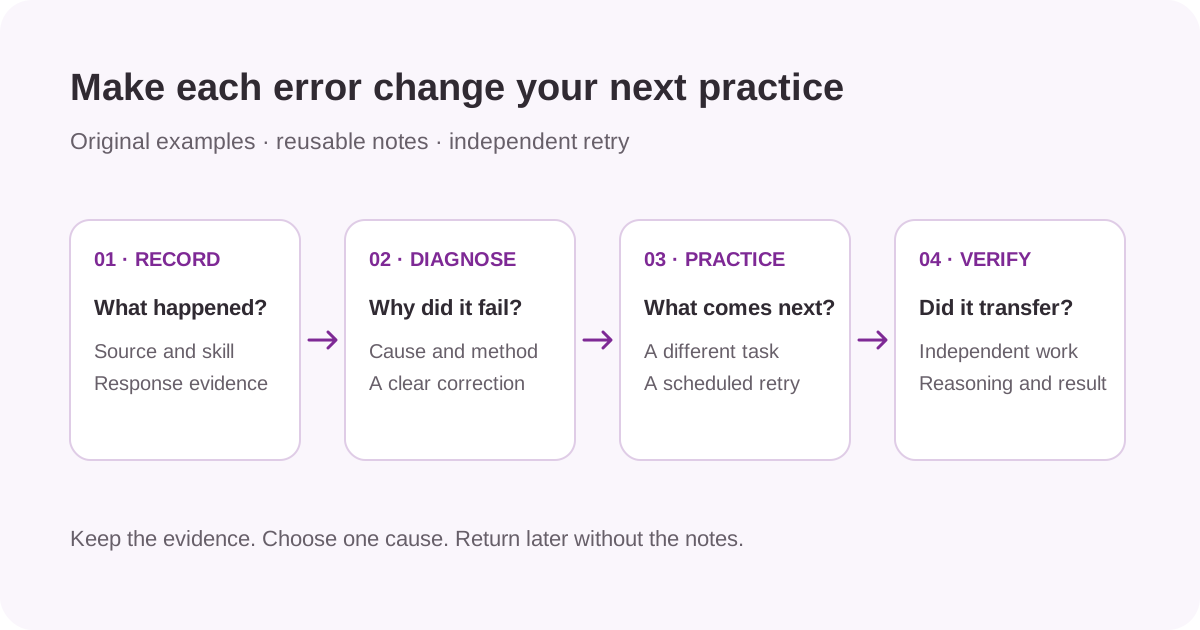
Keep separate notes for genuinely unfamiliar vocabulary or mathematics concepts. The error row can point to that learning task without pretending that memorizing yesterday's explanation fixed it. A next-practice assignment should require the same reasoning on new material; repeating the identical question is useful for explanation, but less convincing as a transfer check.
Five fictional GRE log entries
The examples are invented study observations rather than ETS questions or official scoring comments. They illustrate several causes that a broad label such as “Verbal weakness” would hide. Replace them with references to your own legitimate practice. In particular, a writing revision has no correct answer letter, and the verification should describe the quality of a new argument rather than a made-up score.
| Skill/task | Observed problem | Cause | Correction | Next practice | Later verification |
|---|---|---|---|---|---|
| Verbal: text completion | Picked a familiar word that contradicted a contrast cue. | Matched vocabulary without tracing sentence logic. | Predict the required meaning from the relationship before options. | Explain the logic in three fresh sentences. | State the predicted meaning on a later item. |
| Verbal: reading inference | Selected a broader claim than the passage justified. | Extended the argument beyond the stated evidence. | Identify the smallest supported inference and its text evidence. | Compare two plausible inferences for one passage. | Cite support on a new short passage. |
| Quantitative Comparison: constraints | Assumed a variable was positive when no restriction said so. | Tested only one convenient value. | List stated constraints and test allowed contrasting cases. | Check three new comparisons with explicit counterexamples. | Explain a later comparison using permitted cases. |
| Quantitative: numeric entry | Entered a decimal when the task requested a fraction. | Skipped the required response format at submission. | Read units and response instructions after calculating. | Solve two items and audit the requested format. | Verify format and value on a fresh timed item. |
| Analyze an Issue: development | Asserted a position without addressing a reasonable limitation. | Treated a strong opinion as a developed argument. | Use a relevant example, explanation and qualification. | Revise one paragraph against the official scoring guidance. | Evaluate a new outline for reasons and limitations. |
Use the weekly review to test transfer
Group your rows by sentence logic, inference scope, mathematical constraints, response format or argument development. Select one repeated cause, explain its correction from memory and try a short set of fresh items or a new writing outline. Return later to another unfamiliar task and record whether you could justify the method independently. Reopen a pattern when it recurs. Consult official GRE materials for current format and scoring information. This practical cadence is an editorial recommendation; it does not establish the optimal interval for every learner or promise a score increase.
Official resources and the next step
Check current format details with GRE General Test content and structure. Use the other official sources listed with this guide for legitimate practice and criteria. Access conditions may vary, and some preparation products require payment or an account. This independent guide is not endorsed by the exam owner.
Start with the GRE error log template. Fill one row from your own attempt, choose one concrete correction and schedule a fresh verification. Keep personal identifiers and complete copyrighted questions out of shared copies. Your log should make the next learning decision clearer, not promise an outcome.
Sources and methodology
AI-assisted original English editorial draft prepared in Codex on 2026-10-05. Official exam-provider pages were checked for current format and preparation guidance. The examples are fictional original learning scenarios, not copied test questions or official scored responses. The weekly review loop is a practical editorial suggestion, not a claim that a particular cadence is optimal. This guide offers no score, passing, scholarship or admissions guarantee. Human editorial review was approved by Maksim Mamchur on 2026-10-05.


