
Key takeaways
- GED has four subject tests. Free official previews and the paid GED Ready practice test serve different purposes; this log cannot predict passing or replace official readiness feedback.
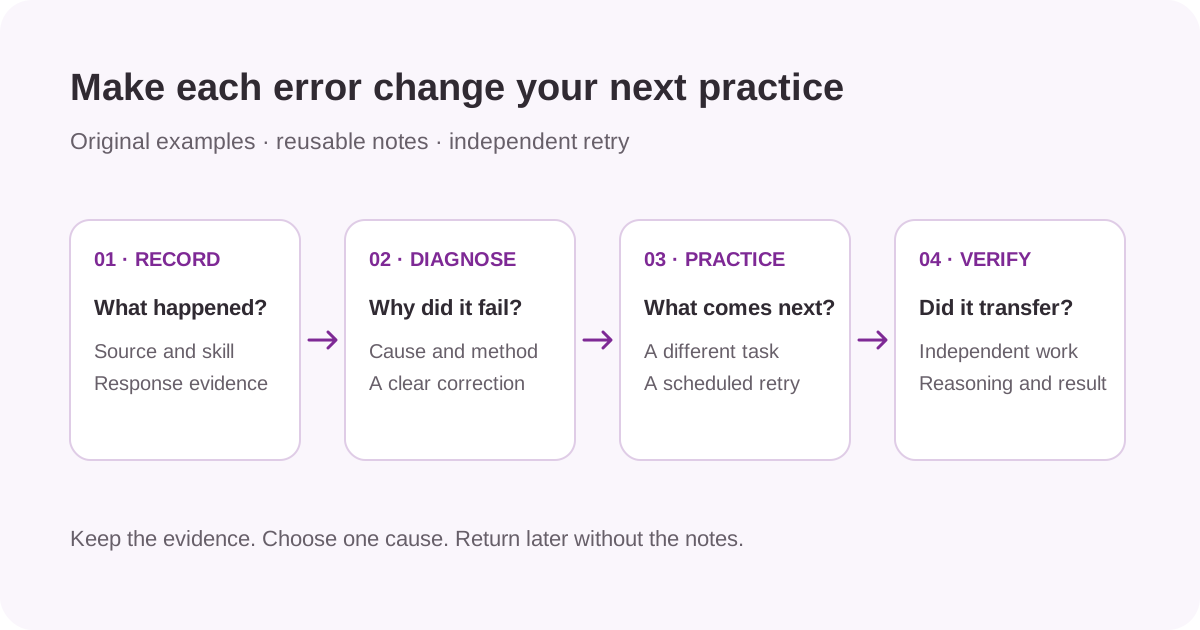
- Separate subject knowledge, representation and instruction-reading errors before choosing the next small task.
- Use a fresh task or response for verification; remembering a reviewed answer is not enough.
- The five examples are fictional and do not reproduce official exam questions.
Keep four subject records with one useful method
GED preparation covers Mathematical Reasoning, Reasoning Through Language Arts, Science and Social Studies as separate subject tests. A GED error log can use one consistent method while keeping the subjects distinct. Start with an official preview or other legitimate practice source and record what your attempt shows. Do not interpret a few sample questions as a readiness score for an entire subject.
Official free previews and GED Ready have different roles. GED Ready is a paid official practice test with readiness feedback; this template does not replace it. If you use that feedback, preserve the subject and date while deciding which skills need practice. An error log is your record of reasoning and revision, not another certification or a way to predict a passing result.
Save the answer evidence and the instruction
For each row, write a source reference, question type and your response. Then identify the answer explanation or writing guidance that supports the correction. In Mathematical Reasoning, keep the relationship, units and response format. In Science and Social Studies, identify the graph, experiment or source detail you misinterpreted. In language arts, point to the part of the text that should have guided the answer.
An extended response needs its own evidence. Preserve a short excerpt of your original writing and describe how its reasoning changes after revision. Summarizing an argument and evaluating its support are different actions. A rubric or teacher discussion can guide that diagnosis; an answer-letter column cannot. Mark uncertain judgments so you do not turn an assumption into a supposed official assessment.
Make the correction possible to use
A good correction is specific enough to apply while solving something new. “Label the fixed fee and the per-hour charge” helps repair an equation setup. “State what was changed and what was measured” helps repair confusion about experimental variables. “Use evidence” is less useful until you name which claim the detail supports and explain the connection.
The next assignment can be small. Try several new fee situations, annotate a different investigation, or revise a single analytical paragraph. When reading a historical or civic source, distinguish the writer's viewpoint from a supported factual claim. If you are missing background knowledge, schedule that review separately from the source-reading skill. Combining the two causes would make it harder to see what improved.
Five fictional GED log entries
These examples illustrate original learning situations across the four GED subjects. They are not official test questions, readiness feedback or scored extended responses. Your actual entries should reference the material you used and preserve your own reasoning. Each verification asks for a new piece of evidence, so the row stays open until you can demonstrate the correction beyond the example you already reviewed.
| Skill/task | Observed problem | Cause | Correction | Next practice | Later verification |
|---|---|---|---|---|---|
| Mathematical Reasoning: equation setup | Added a fee once for each hour instead of once overall. | Misread a fixed charge as a variable charge. | Label the fixed amount and per-unit rate before writing an equation. | Model three unfamiliar fee situations. | Explain each term in a later equation. |
| Reasoning Through Language Arts: evidence | Selected a detail that did not support the author's claim. | Chose a relevant topic rather than relevant evidence. | Connect the detail to the exact claim in one sentence. | Compare two possible pieces of support. | Explain support on a new short passage. |
| RLA extended response: analysis | Summarized both arguments without evaluating their support. | Did not distinguish summary from evidence-based analysis. | Compare the quality and relevance of support using text details. | Revise a paragraph against the official response guidance. | Check a fresh paragraph for an explained comparison. |
| Science: variables | Called the measured outcome the independent variable. | Mixed up what was changed and what was observed. | State changed factor, measured outcome and controlled conditions. | Label variables in two new investigations. | Identify roles in an unfamiliar study. |
| Social Studies: source interpretation | Treated the author's opinion as an established fact. | Ignored the source's purpose and wording. | Identify the claim, supporting evidence and viewpoint separately. | Annotate two short historical or civic sources. | Support a later interpretation with source details. |
Review one subject and one pattern at a time
During a weekly review, select a subject and group its rows by recurring cause. Explain one correction without looking at the previous answer. Complete a small unfamiliar practice set or produce a new paragraph, then revisit the skill later and record the result. Distinguish an independently solved task from one completed with help. Ask an instructor about rows whose explanations remain unclear. Use official GED resources for test policies and readiness information. The suggested review loop is a planning aid, not a proven ideal timetable, passing guarantee or substitute for official guidance.
Official resources and the next step
Check current format details with GED subject tests. Use the other official sources listed with this guide for legitimate practice and criteria. Access conditions may vary, and some preparation products require payment or an account. This independent guide is not endorsed by the exam owner.
Start with the GED error log template. Fill one row from your own attempt, choose one concrete correction and schedule a fresh verification. Keep personal identifiers and complete copyrighted questions out of shared copies. Your log should make the next learning decision clearer, not promise an outcome.
Sources and methodology
AI-assisted original English editorial draft prepared in Codex on 2026-10-05. Official exam-provider pages were checked for current format and preparation guidance. The examples are fictional original learning scenarios, not copied test questions or official scored responses. The weekly review loop is a practical editorial suggestion, not a claim that a particular cadence is optimal. This guide offers no score, passing, scholarship or admissions guarantee. Human editorial review was approved by Maksim Mamchur on 2026-10-05.


