Earn Money Teaching Online: Proven Techniques for Educators
Explore proven techniques to earn money teaching online. This guide provides practical tips for educators to create profitable online courses and maximize earnings.
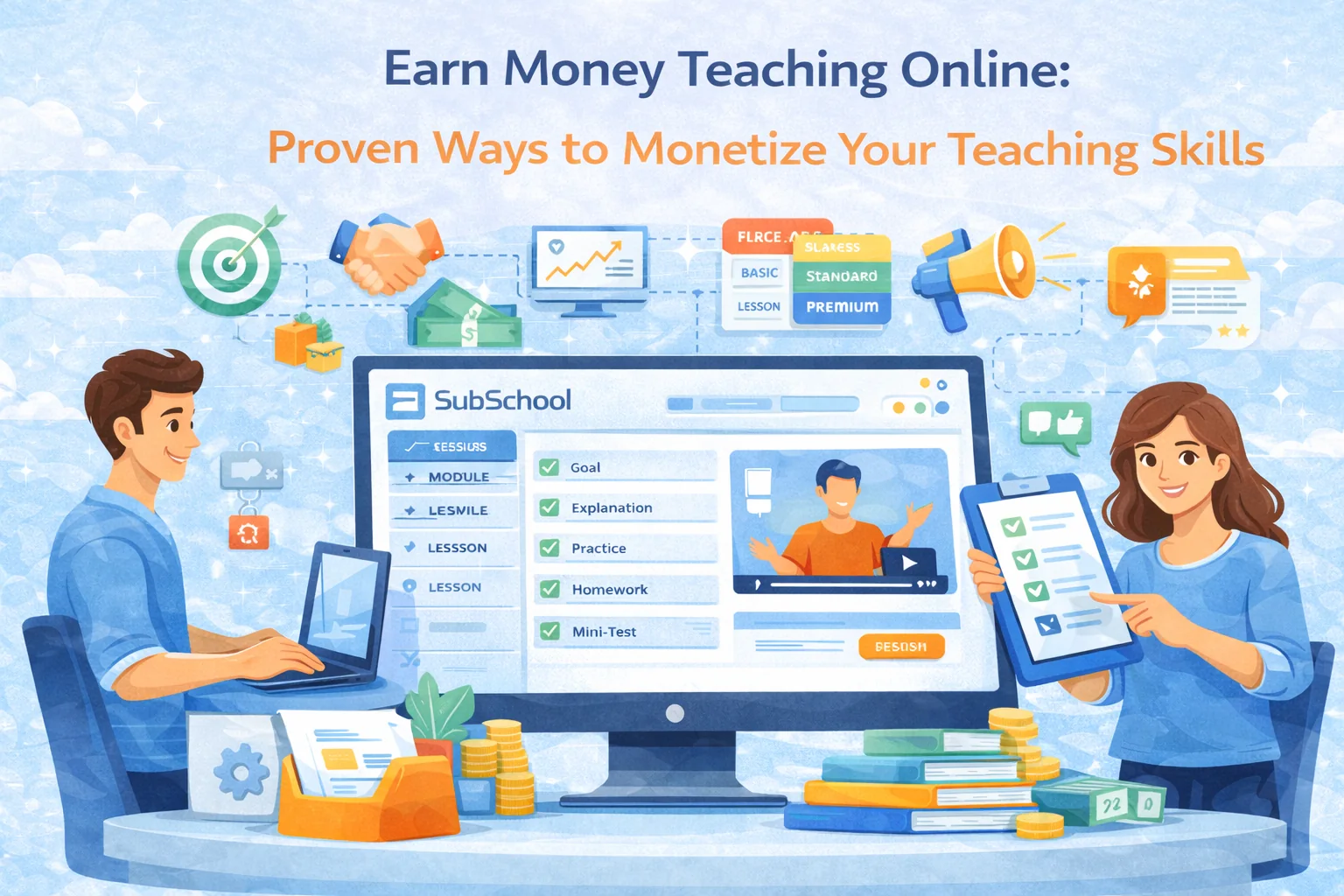
Earn Money Teaching Online: Proven Ways to Monetize Your Teaching Skills
The internet didn’t just “move education online” — it created multiple income streams for teachers, tutors, and subject experts. The difference between “I tried teaching online and it didn’t work” and “I replaced my salary” is usually not talent — it’s positioning + offer design + distribution + retention.
This guide breaks down the real playbook: how to choose what to teach, how to price it, how to market it without becoming a full-time influencer, and how to set up a system that scales. I’ll also point out where an all-in-one platform like SubSchool reduces the annoying parts (payments, course delivery, homework flow, etc.).
Identifying Your Market
Targeting the Right Audience
Start by picking a specific buyer, not a broad “anyone who wants to learn math/English.” Broad markets are crowded and price-competitive. Specific markets buy faster and pay more.
Use this simple targeting formula:
- Who: (parents of 6th graders / adult immigrants learning English / junior devs prepping for interviews)
- Goal: (raise grade from C→A / pass IELTS 7.0 / land first job)
- Deadline: (in 8 weeks / by May exam / “asap”)
- Constraint: (busy schedule / low confidence / weak fundamentals)
Examples of “sellable” niches:
- “SAT Math: 480→620 in 6 weeks”
- “English for Nurses: workplace communication + documentation”
- “Physics problem-solving bootcamp for AP/IB”
- “Junior PM interview practice with feedback (video/voice)”
Quick validation (do this before building anything big):
- Search your topic + “tutor” / “course” / “bootcamp”
- Check how people phrase pain: “struggling with…”, “how to…”, “best way to…”
- Ask 10 potential buyers one question:
- “If you could solve ONE problem in this subject in the next 30–60 days, what would it be?”
- Your offer should answer that.
Crafting High-Quality Content
Delivering Valuable Knowledge
High-quality content is not “long.” It’s clear, structured, and outcome-driven.
A simple structure that works for almost any subject:
- Explain the concept (short, no fluff)
- Show an example (worked solution / demonstration)
- Guided practice (student does it with hints)
- Independent practice (homework)
- Feedback loop (grading + corrections + next task)
If you’re building a course, design it around skills, not “chapters.”
- Bad: “Module 1: Algebra basics”
- Better: “Skill 1: Solve linear equations fast and reliably”
- Best: “Skill 1: Solve linear equations in <90 seconds with 95% accuracy”
Leveraging Multimedia Tools
You don’t need fancy production. You need the right format per job:
- Video (5–12 min): explanation + demonstration
- Text lesson: summary + cheat sheet + common mistakes
- Homework: the real learning happens here
- Mini-tests: keep attention, measure progress
- Live lesson: feedback, coaching, motivation, Q&A
On platforms like SubSchool, the advantage is that your course isn’t “just videos” — you can package lessons + homework + grading + chat + live sessions into one flow, which makes it easier for students to stay consistent (and consistency = results = reviews = more sales).
Effective Pricing Strategies
Balancing Value and Affordability
Pricing isn’t “how long did it take me to make.” Pricing is:
- Outcome value (exam passed, job landed, grade improved)
- Speed (how fast they get results)
- Support level (self-paced vs feedback vs live coaching)
- Risk reduction (trial lessons, module purchase, refund policy)
If you’re unsure, start with a tiered structure.
Offering Tiered Pricing and Bundles
This is the cleanest way to earn more without feeling “salesy”:
Tier 1 — Self-paced
- Recorded lessons + homework
- Minimal support
- Lowest price, highest scalability
Tier 2 — Guided
- Everything in Tier 1
- Weekly check-ins or office hours
- Homework review (light)
Tier 3 — Coaching / Tutoring
- Personal plan + deep feedback
- Live sessions
- Highest price, limited spots
Bundling that converts well:
- “Course + 2 tutoring sessions”
- “Exam prep bundle (course + weekly live review + mock exams)”
- “Pay monthly subscription for ongoing practice + feedback”
Also: let people buy a module / single lesson to try before committing (reduces purchase friction). If your platform supports it, that’s a conversion lever.
Marketing and Promotion
Building an Online Presence
You don’t need to dance on TikTok (unless you enjoy it). You need a repeatable system that produces trust.
Content that brings students:
- “Explain one common mistake” posts
- “How to solve X in 3 steps” mini-lessons
- Before/after case breakdowns (anonymous)
- Exam strategy checklists
- Short diagnostic quizzes (“Comment ‘TEST’ and I’ll send a mini-test”)
A practical posting plan (doesn’t kill your life):
- 2 short posts/week: tips + mistake breakdown
- 1 longer piece/week: YouTube, blog, or a full “how-to”
- 1 CTA/week: “I’m taking 5 students for X goal by Y date”
Your goal is not “followers.” Your goal is qualified conversations.
Utilising Testimonials and Social Proof
Social proof is gasoline — but it must be credible.
What to collect:
- Starting point (score/grade/problem)
- What you did together (method)
- Outcome (measurable)
- Short quote (emotional + practical)
If you don’t have many results yet:
- Use process proof: screenshots of lesson plan, homework examples, student engagement (without personal data)
- Use micro-wins: “In week 2, she stopped making this mistake…”
Choosing the Right Platform
Aligning with User-Friendly Platforms
A platform should reduce the admin chaos:
- course structure
- homework creation and submissions
- feedback/grading loop
- payments
- communication (chat)
- live lessons scheduling/links/recordings
An all-in-one tool like SubSchool is especially valuable when you want to combine courses + tutoring + saleswithout duct-taping five different services together.
Understanding Platform Policies and Fees
Two things matter more than people admit:
- Fees/commission — affects your real income and pricing flexibility
- Ownership — do you own your students/audience or are you renting them?
If you rely heavily on marketplaces, you gain traffic but lose margin/control. If you sell directly, you keep control but must do marketing. Many educators do a hybrid:
- marketplace for discovery
- direct platform for better margins + long-term retention
Expanding Your Reach
Collaborating and Networking
Fastest growth tactic that doesn’t require ads:
- Partner with adjacent teachers (math + physics, English + history)
- Joint webinars (“Exam strategies night”)
- Cross-referrals (“I’ll send you my students who need grammar, you send me yours who need speaking”)
This works best when you have a clear niche outcome and a clean offer.
Continuous Learning and Adaptation
The best teachers iterate like product managers:
- Track what students fail
- Update lessons based on real mistakes
- Improve homework sets
- Add mini-tests
This increases completion rates and reviews — and reviews are basically free marketing.
Conclusion
Making money teaching online is not a mystery. It’s a system:
- Pick a clear niche outcome
- Package it into a structured learning flow (lessons → homework → feedback)
- Price with tiers so you can serve different budgets
- Market with useful content that solves real problems
- Use a platform that reduces admin and supports selling + delivery (like SubSchool)
- Iterate based on student results, not your gut feelings
If you want, I can also turn this into:
- a tighter SEO-first version (more “keyword-dense” without sounding spammy),
- a landing-page version (CTA-focused),
- or a “1-hour implementation checklist” for teachers launching their first paid offer.