
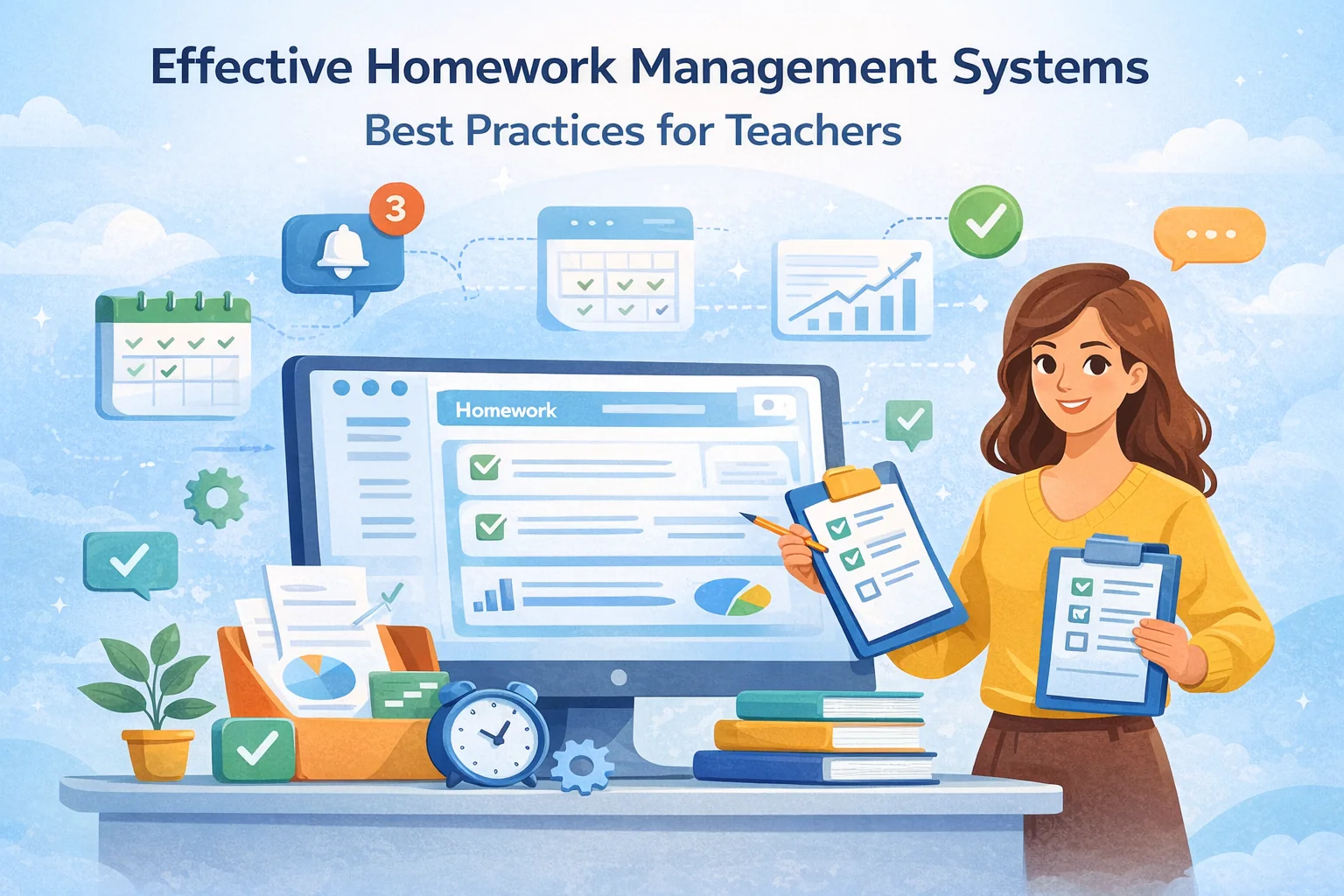
Homework Management Systems: How to Assign, Track, and Improve Learning Without Drowning in Admin
In the digital era of education, a “homework management system” isn’t a fancy add-on — it’s the difference between a course that scales and a course that collapses into missed submissions, endless reminders, and late-night grading.
Platforms like SubSchool make homework feel like a workflow instead of chaos: assignments attached to lessons, submissions in one place, feedback loops that don’t require your soul as payment, and (when you want it) AI that helps generate and grade work — including essays and interview-style video answers.
This guide explains how to use homework management properly: what to set up, how to structure assignments, how to give feedback efficiently, and how to use performance data to improve outcomes.
The Importance of Effective Homework Management
Enhancing the Role of Homework in Education
Homework works when it’s part of a loop — not a random “go practice” instruction.
The learning loop that drives real improvement:
- Explain a concept (lesson content)
- Practice it (homework)
- Get feedback quickly (grading + comments)
- Fix mistakes (targeted follow-up)
- Repeat with slightly higher difficulty
When homework is unmanaged, that loop breaks:
- Students don’t know what to do (or do the wrong thing).
- You don’t see patterns (only individual complaints).
- Feedback arrives too late to matter.
- Motivation dies because progress feels invisible.
A homework management system fixes this by making homework:
- clear (instructions + format + rubric)
- trackable (who did what, when, and how well)
- actionable (mistakes become a plan, not a mystery)
Selecting the Right Homework Management System
Key Features to Consider
Most systems claim they “support homework.” What you actually need is a system that supports the teacher workflowand the student experience at the same time.
Here’s what to look for:
1) Assignment creation that doesn’t waste your life
- reusable templates (“copy homework from Lesson 3 to Lesson 9”)
- question banks / exercise libraries
- ability to attach materials (video, slides, text)
- different formats: multiple choice, open answer, file upload, essay, video response
2) Clear submission + status tracking
- who hasn’t started
- who submitted late
- who needs revision
- what’s pending grading
3) Fast feedback tools
- rubrics (so you’re not rewriting the same feedback 30 times)
- inline comments / timestamps (for essays/videos)
- auto-check for structured answers (math, short answers, formats)
4) Learning analytics that lead to decisions
You don’t just want charts. You want answers like:
- “Which skill is the class failing?”
- “Which students are stuck vs rushing?”
- “What mistakes repeat every week?”
5) Accessibility
- works on mobile
- low-friction login
- simple submission flow (few clicks, not 12 tabs)
6) Automation (optional but powerful)
A modern system can help by:
- generating homework from your lesson material (fixed sets or adaptive sets)
- doing first-pass grading for essays or interview-style answers
- validating that “wrong” isn’t just formatting or interpretation
(Automation should make you faster — not remove your control.)
Evaluating User-Friendly Platforms
A “good” platform is one that students will actually use consistently — and that you can run without becoming part-time tech support.
A simple evaluation test:
Can a student do this in under 60 seconds?
- find the assignment
- understand what to submit
- submit it successfully
- see what happens next (graded? feedback? revision?)
And for teachers:
Can you do this in under 3 minutes?
- create homework
- reuse a previous one
- check submissions
- give feedback quickly
- identify who needs help
SubSchool’s advantage here (when implemented well) is that homework is tightly connected to the course flow: lesson → assignment → submission → feedback — plus optional AI support for generating/adapting/grading.
Integrating Homework Management into Your Teaching
Streamlining Assignment Creation and Distribution
The biggest mistake teachers make: assignments that are vague.
A good homework task has four parts (always):
- Goal: what skill this practices
- Task: what to do
- Submission format: what exactly to submit
- Success criteria: how it will be graded
If you do nothing else from this article, do this.
Example template (copy/paste)
Goal: Practice ___
Task: Do ___ (steps / constraints)
Submit: ___ (file / text / video, length, format)
Success looks like: ___ (rubric bullets)
Concrete examples
Math / structured subject
- Goal: Solve linear equations with fractions
- Task: Solve 10 problems. Show full steps for #3, #7, #10.
- Submit: Photos or typed solution.
- Success looks like: correct method + correct final answers + clean steps.
Language / writing
- Goal: Use past tense consistently + improve clarity
- Task: Write 180–220 words about “your last weekend.” Use at least 6 past-tense verbs.
- Submit: Text
- Success looks like: grammar accuracy, vocabulary, coherence, no major errors.
Exam prep
- Goal: Reduce careless mistakes in timed conditions
- Task: Do a 12-question mini-test in 18 minutes; mark which questions felt uncertain
- Submit: answers + “uncertainty list”
- Success looks like: score + error types categorized.
That structure makes homework “self-running.”
Facilitating Timely Feedback and Grades
Feedback is where most teachers burn out. The goal isn’t “grade everything perfectly.” The goal is:
give the right feedback to the right student at the right time — fast.
Use a 3-layer feedback system
Layer 1 — Automatic checks (fast)
- correctness checks for structured answers
- format validation (so students don’t fail because they typed “2,5” instead of “2.5”)
- basic rule checks (word count, required elements)
Layer 2 — Rubric grading (consistent)
Make a rubric once, reuse it forever:
- Accuracy (0–5)
- Method / reasoning (0–5)
- Clarity (0–3)
- Completeness (0–2)
Layer 3 — “One lever” personal comment (high impact)
One short comment that moves the student forward:
- “Your reasoning is right, but you skip steps — write the transformation line by line.”
- “You answered the prompt, but your examples are generic — add 2 specific details.”
With SubSchool-style AI grading for essays/interviews, you can make this even faster:
- AI does first-pass scoring + highlights weak spots
- you confirm + add a short personal note
- That’s the sane way to scale quality.
Enhancing Student Engagement and Responsibility
Encouraging Student Autonomy
Homework management is secretly a motivation system. Students stay engaged when they feel:
- they know what to do
- they can measure progress
- effort leads to visible improvement
Practical tactics that boost completion
1) Timebox assignments
Instead of “Do these 30 problems,” use:
- “Spend 25 minutes. Stop when time ends. Mark what you couldn’t do.”
Students complete timeboxed tasks more reliably.
2) Add a “start here” instruction
Many students don’t start because starting feels hard.
Add: “Do #1 and #2 only first. If that goes well, continue.”
3) Make revisions normal
Let students resubmit once.
This shifts homework from punishment to improvement.
4) Use micro-deadlines
Instead of one weekly submission:
- Draft due Wednesday
- Final due Friday
- Even adult learners behave better with checkpoints.
Interactive and Collaborative Assignments
Homework doesn’t have to be lonely.
Ideas that work well online:
- Peer review: students exchange answers and comment using a checklist (“Is the reasoning clear?”)
- Discussion prompts: “Post your solution approach and ask one question.”
- Group mini-projects: 2–3 students create a short explanation video, slides, or summary.
The trick is to give structure, not freedom:
- roles (summarizer, checker, presenter)
- clear output format
- simple rubric
If your platform has course chat + 1:1 chat, keep collaboration inside the same space where assignments live — otherwise it fragments and dies.
Tracking and Analysing Student Performance
Monitoring Progress Over Time
Tracking isn’t about surveillance; it’s about catching problems early.
What you should track at minimum:
- completion rate
- average score
- time-to-submit
- revision count
- common error types
And the most valuable metric:
“What % of the class is stuck on the same concept?”
That tells you what to reteach.
Tailoring Instruction Based on Data
Data is only useful if it triggers action.
Here are decision rules that work:
If 30%+ miss the same skill → reteach it (don’t just “review”).
- do a short targeted mini-lesson
- assign a focused practice set
If a student submits late repeatedly → reduce scope, increase frequency.
- smaller tasks more often
- build consistency first
If a student scores high but makes random mistakes → add timed checks.
- mini-tests
- format validation
- “explain your reasoning” prompts
If a student writes essays with weak structure → teach structure explicitly.
- give a template (intro → 2 arguments → conclusion)
- grade structure separately from content
Adaptive homework makes this easier: performance → next set → targeted practice. That’s how you get personalization without manual effort.
Overcoming Challenges with Homework Management
Addressing Technological Barriers
The goal is not “teach tech.” The goal is remove friction.
Do this:
- one onboarding message pinned in the course
- one “how to submit” mini video (30 seconds)
- one support path: “If submission fails, message here”
Also: don’t introduce five tools. Use one system for content + homework + feedback whenever possible.
Ensuring Equity and Access
Equity issues show up fast with online homework:
- device limitations
- unstable internet
- time constraints (work, family)
What helps:
- mobile-friendly submission
- low-bandwidth alternatives (text instead of large files)
- flexible windows (24–48 hours)
- optional “offline mode” tasks where students can submit photos later
The key is not lowering standards — it’s lowering friction.
Best Practices for Using Homework Management Systems
Consistency and Clarity in Assignments
A simple rule:
If students ask you “what do we do?” more than twice, your assignment is unclear.
Checklist before publishing homework:
- goal is stated
- exact output format is stated
- example of a good submission exists
- grading criteria is visible
- estimated time is included
Integrating Diverse Types of Assignments
Use variety strategically — not randomly.
A healthy homework mix:
- practice (skill repetition)
- application (real-world scenario)
- reflection (what went wrong + why)
- assessment (mini-test)
- expression (essay / video interview)
If your platform supports essays + video responses + automatic checks, you can rotate formats without increasing grading load.
Conclusion
A homework management system is not just an organizer — it’s how you scale learning quality without burning out.
Used well, it gives you:
- faster assignment creation
- cleaner submissions
- quicker feedback
- stronger engagement
- performance data that tells you what to teach next
Platforms like SubSchool are especially powerful when you combine:
lesson materials → homework generation (fixed or adaptive) → submission → AI-assisted grading → targeted follow-up.
That’s the modern homework loop: simple, measurable, and sustainable.
Homework workflow status model
This is a recommended operating model, not the exact SubSchool state machine. Current product states differ, and “revision requested” or “reused” are not first-class assignment statuses.
Recommended sequence
Assigned → Opened → In progress → Submitted → Revision requested → Reviewed → Reused
Teacher checklist
- Define evidence and response format before assigning
- Check accessibility, originality, and workload
- Review submitted evidence beside the prompt
- Name one actionable revision
- Choose whether and when the task should resurface
Student checklist
- Restate the task and success evidence
- Save a draft before submitting
- Attach only authorised and relevant files
- Read AI and teacher comments critically
- Revise the specific evidence, not only surface wording
Useful next step
Generate one editable homework set
Use anonymised lesson context, review every task, then open the real exercise-set workspace if the set is worth building.