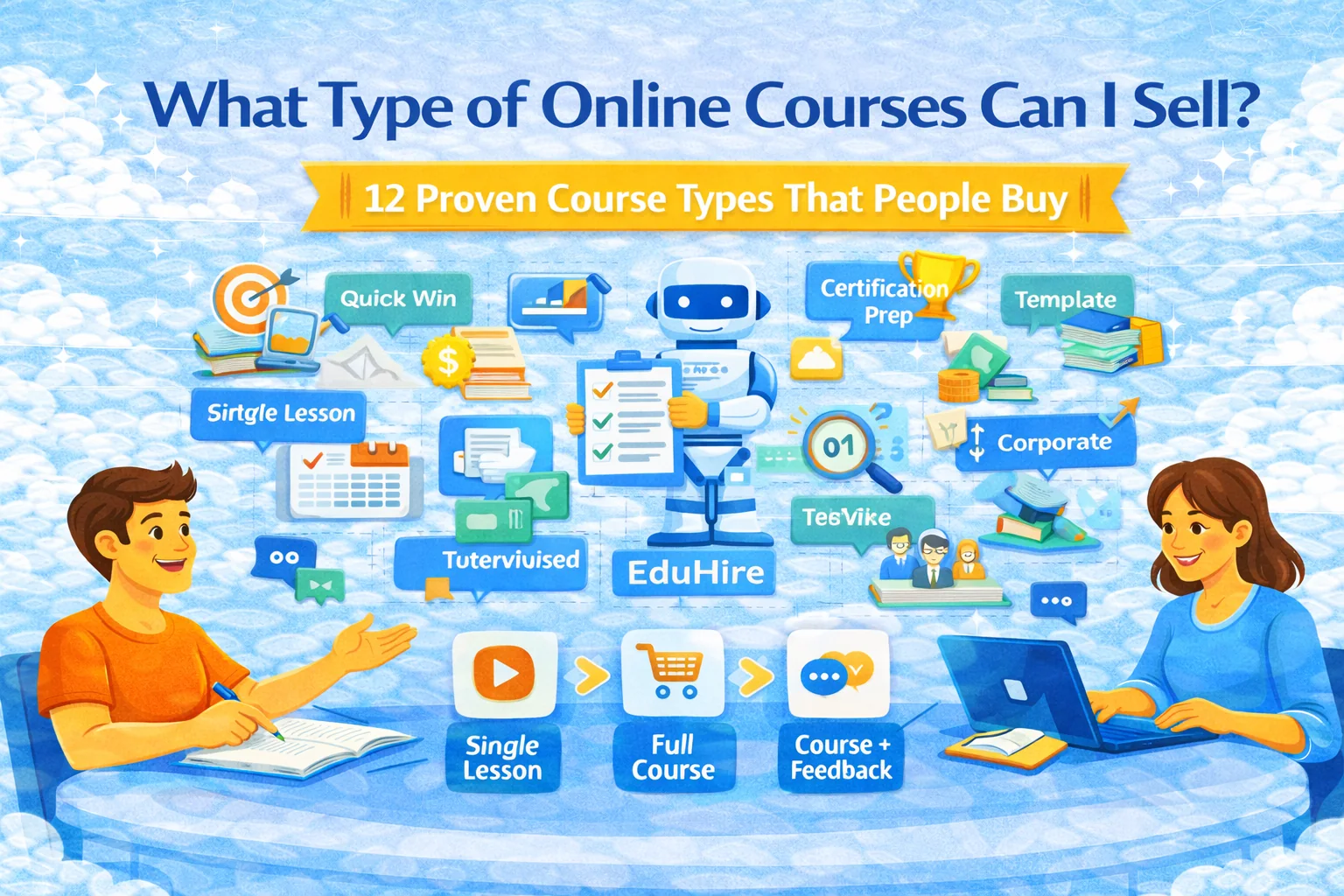
What type of online courses can you sell?
You can sell almost any course. The real question is: which course type sells fastest, gets completed, and doesn’t trap you in endless support?
The answer depends on why someone buys:
- to solve a painful problem fast
- to gain a job-relevant skill
- to pass an exam / get credentialed
- to get feedback on their work
- to save time / reduce risk at work
Below are 12 course types that consistently match those buying motives—plus a framework to pick the best one for you.
And yes: whatever you choose, you can package it inside SubSchool, sell it as a full course or single lessons, and (if you want) let AI help structure lessons from videos and generate homework from lesson context inside SubSchool.
The “Sellability” test (pick course types that pass)
Before you pick a niche, test the shape of the course idea:
A course sells when it has:
- A clear outcome (“I can now do X”)
- A clear deadline or urgency (exam date, job search, business pain)
- A clear artifact (portfolio piece, template, certificate, plan, score)
- A clear audience (not “everyone”)
If your idea fails any of these, don’t panic—just choose a different course type below.
12 course types that people buy (with examples)
1) The “Quick Win” Micro-Course (30–120 minutes)
Why it sells: low risk, fast value, impulse-friendly.
Best for: creators who want traction and reviews fast.
Examples:
- “Fix your resume in 60 minutes”
- “Set up Notion for weekly planning”
- “SAT essay: 5 templates that score”
How to sell it on SubSchool: list it as a small course or sell it as single lessons on SubSchool to reduce buyer hesitation.
2) The Skill Sprint (1–3 weeks)
Why it sells: short, structured, feels achievable.
Best for: practical skills where repetition matters.
Examples:
- “Conversational English for work calls in 14 days”
- “Excel dashboards in 10 sessions”
- “Intro to Python for analysts”
3) The Project-Based Course (portfolio outcome)
Why it sells: students leave with something they can show.
Best for: design, data, coding, marketing, product, writing.
Examples:
- “Build a landing page that converts”
- “Create a data dashboard from raw CSV”
- “Write 10 customer support macros + tone guide”
Make it stronger: include a rubric + examples of “good vs bad.”
4) The Certification / Exam Prep Course
Why it sells: deadline + stakes + measurable improvement.
Best for: SAT/ACT, language tests, industry certs, internal company exams.
Examples:
- “Pass the CompTIA exam in 30 days (practice-first)”
- “SAT Math score boost plan”
Power move: sell Lesson 1 as a diagnostic + study plan on SubSchool, then upsell the full program inside SubSchool.
5) The Cohort Course (live, group-based)
Why it sells: accountability + community + “I’ll actually finish this.”
Best for: topics where motivation is the hard part.
Examples:
- “Public speaking bootcamp (4 weeks)”
- “Write your first short story (live workshop)”
Rule: live time must be practice + feedback, not 90 minutes of lecturing.
6) The Feedback Course (you sell critiques, not content)
Why it sells: people want a coach, not another video.
Best for: writing, speaking, design, interview prep, sales.
Examples:
- “Weekly feedback on your writing + improvement plan”
- “Mock interviews with structured scoring”
This maps cleanly to SubSchool if you structure lessons and attach assignments; homework can be AI-generated and refined per lesson inside SubSchool.
7) The Template / SOP Course (business productivity)
Why it sells: time-saving and immediately applicable.
Best for: business operations, customer support, HR, PM, marketing.
Examples:
- “Customer support playbook: macros + escalation rules”
- “Hiring pipeline templates for small startups”
Deliverables matter more than filming quality here.
8) The “Transformation” Course (identity + lifestyle change)
Why it sells: aspirational outcomes (“I become X”).
Best for: creators with strong personal brand.
Examples:
- “From procrastination to consistent weekly system”
- “Build confidence speaking English”
Warning: this category needs stronger proof/testimonials and careful claims.
9) The Tutor-to-Course (convert 1:1 tutoring into scalable product)
Why it sells: you already know what students struggle with.
Best for: tutors and teachers.
Flow:
- tutor 10–20 sessions
- record your best explanations
- build a structured course
- keep premium tutoring only for hard cases
On SubSchool, you can sell single lessons as “try before buy,” then convert to full course inside SubSchool.
10) The Corporate Training Course (internal upskilling)
Why it sells: companies pay for reduced mistakes and faster onboarding.
Best for: compliance, SOPs, sales scripts, onboarding, tooling.
Examples:
- “New SDR onboarding: call structure + objections”
- “Support onboarding: policy + tone + scenarios”
If you’re building corporate training, SubSchool fits the “structured learning + homework + tracking” pattern inside SubSchool.
11) The EduHire Course (training + evaluation)
Why it sells: organizations want to teach + assess + hire with evidence.
Best for: hiring funnels, internships, junior roles.
Example:
- “Junior PM track + interview-format tasks”
- “Customer support candidate screening course”
This is exactly the kind of “interview task inside course” flow SubSchool is positioned for.
12) The Membership / Library (ongoing updates)
Why it sells: continuous value + new content.
Best for: fast-changing skills (tools, marketing, AI workflows).
Examples:
- “Monthly prompt packs + workflows”
- “New lesson every week + office hours”
Hard truth: don’t start with membership unless you already have consistent demand. Start with a flagship course, then convert.
How to choose the best course type (fast framework)
Use this decision matrix:
If you want sales fastest
Pick: Micro-course, Skill sprint, Exam prep, Template/SOP
Reason: simple promise + short time-to-value.
If you want higher pricing
Pick: Cohort, Feedback course, EduHire, Corporate training
Reason: outcomes depend on feedback and accountability.
If you want scalability
Pick: Project-based, Tutor-to-course, Template/SOP, Membership
Reason: reusable assets + fewer live hours.
What to avoid (or handle carefully)
Not because it’s “illegal,” but because it’s high-risk:
- Medical / mental health / legal advice as definitive prescriptions
- “Guarantee income” or results you can’t control
- Courses for minors without clear privacy/consent policies
- Using copyrighted materials without permission
You can still teach adjacent skills, but you need better disclaimers, safer framing, and cleaner materials.
Packaging tip that increases conversions immediately
Offer 3 entry levels:
- Single lesson (low-risk trial)
- Full course (best value)
- Course + feedback (premium)
This is one of the cleanest monetization setups on SubSchool because selling single lessons is built into the “try first” logic on SubSchool.
Resources
- Creative Commons — license chooser
- U.S. Copyright Office — Copyright Basics (PDF)
- FTC — Endorsement Guides (truth in advertising for testimonials)
- FTC — “Disclosures 101” (how to disclose paid relationships)
- U.S. Small Business Administration — market research basics
- IRS — Self-Employed Individuals Tax Center
Compare course types before choosing one
Use the learner outcome, delivery format, support load, and buying model to narrow the idea before producing more content.
Twelve course types compared
| Type | Outcome / audience | Format / support | Pricing model | Best when | Avoid when |
|---|---|---|---|---|---|
| Foundations course | Build prerequisite knowledge; true beginners | Short lessons + guided practice; medium | One-time or cohort | Later learning depends on a shared base | Audience already has mixed advanced needs |
| Exam-prep course | Apply current specification skills; exam candidates | Diagnostic + original practice; high update/review | Course, cohort, or tutoring tier | You can maintain current official alignment | You rely on copied questions or score guarantees |
| Project course | Produce a portfolio artefact; applied learners | Milestones + critique; high feedback | Premium or cohort | Outcome is visible and feedback matters | No reviewer capacity exists |
| Skills sprint | Complete one narrow job; time-limited learners | 1–2 weeks; low/medium support | Low one-time price | The skill can stand alone | The promise hides large prerequisites |
| Cohort course | Progress with schedule and peers; motivated group | Live + asynchronous; high facilitation | Cohort fee | Shared pace adds accountability | Availability or moderation is weak |
| Self-paced course | Learn flexibly; independent learners | Recorded/readable + checks; low recurring support | One-time or subscription | Content is stable and recovery paths are clear | Learners require frequent personal feedback |
| Course + tutoring | Build knowledge then target gaps; mixed-need learners | Self-paced core + booked sessions; high targeted support | Course plus session/package | Live time is reserved for evidence-based help | Scope and scheduling are unclear |
| Single paid lesson | Solve one useful problem; cautious buyer | Standalone lesson; low/medium | Per lesson | A lower-risk first step has independent value | It is only a teaser with no usable outcome |
| Micro-credential pathway | Demonstrate a defined competence; professional learner | Assessments + review; high validity load | Programme fee | Evidence and issuing rules are credible | A certificate substitutes for valid assessment |
| Membership library | Ongoing access and updates; repeat learners | Library + events/support; continuous | Subscription | New value is delivered consistently | It is a static archive with recurring billing |
| Teacher-resource course | Apply a classroom workflow; educators | Models + templates + reflection; medium | One-time or school licence | Materials transfer to real teaching decisions | Claims lack classroom evidence |
| Corporate training | Perform a job task; team or organisation | Role scenarios + reporting; high stakeholder load | Seat, cohort, or contract | Requirements and evidence are defined | You promise enterprise SIS/LMS integration that does not exist |
Course idea validation checklist
- Name one learner and one observable outcome
- Interview or observe the target learner problem
- Test prerequisite and willingness-to-pay assumptions
- Prototype one useful lesson and one evidence task
- Estimate support, feedback, update, and acquisition load
- State who should not buy the course
Five-question selector
- Does the outcome require feedback on learner work?
- Is the content stable enough for self-paced delivery?
- Does a schedule or peer group materially improve completion?
- Can a single lesson deliver standalone value?
- Can you maintain sources, practice, and support after launch?
Useful next step
Generate a private course-outline example
Use the free outline tool first. If the structure survives review, recreate it as an authenticated course draft.