As we move deeper into 2026, education is doing what it always does: following people. And people are online, mobile, busy, and allergic to rigid schedules.
Online education isn’t “the future” anymore — it’s the default option for a huge chunk of learners. The real shift now is quality: students don’t just want access, they want outcomes, structure, feedback, and a learning experience that doesn’t feel like a sad PDF with a PayPal button.
So why is education heading online so aggressively — and why does online course creation sit at the center of it? Let’s break it down in a way that’s actually useful.
The Rising Demand for Online Education
Online learning grew up. It’s not only for “I’ll watch this someday” video libraries. In 2026, demand is driven by a few practical forces:
1) Convenience isn’t a “perk” — it’s survival
People learn between everything else:
- work and side gigs
- family and childcare
- relocation and travel
- uneven schedules and time zones
Online courses let learners study when life allows, not when a building is open.
2) Flexibility wins because learners aren’t identical
A classroom moves at one speed. Online learning can support:
- self-paced learners who need repetition
- fast learners who want to skip basics
- learners who want short sessions (10–20 minutes) instead of “2-hour lectures”
The best modern courses are modular: learners can jump to what they need, rewatch what matters, and track what’s done.
3) Cost-effectiveness is real (and not only about tuition)
Students save on:
- commuting and time cost
- printed materials (most content is digital)
- “bundled” tuition where they pay for stuff they don’t need
And educators save too:
- no venue logistics
- no admin chaos
- no “collect payments manually and chase people” circus
4) Outcomes matter more than credentials
A growing slice of learners doesn’t care about a diploma — they care about:
- passing an exam
- getting hired
- upgrading a skill
- building a portfolio
- improving grades this semester
Online courses map perfectly to this: clear goal → structured plan → measurable progress.
The Power of Online Course Creation
Online learning scales because educators can package and deliver knowledge as a product — not just as hours of teaching.
That’s the engine: online course creation.
When you create an online course properly, you can design an experience that’s often better than a traditional classroom, because it’s:
1) Designed — not improvised
A classroom lesson can be brilliant… or it can be “I’m winging it today.”
A well-built online course forces clarity:
- What’s the goal?
- What’s the path?
- What should the learner practice?
- How will they know they’re improving?
That structure is gold — for students and for you.
2) Repeatable (meaning: your effort multiplies)
Instead of repeating the same explanations 200 times, you build once and reuse:
- recorded explanations for core concepts
- reusable exercises
- templates, checklists, examples
- live lessons for feedback, coaching, Q&A
This is how educators stop trading only time for money.
3) More engaging than people assume
The outdated model is “video + quiz + goodbye.”
Modern courses use:
- interactive assignments
- real projects and rubrics
- discussion prompts that aren’t cringe
- checkpoints, diagnostics, and progress tracking
- live sessions used strategically (not as a replacement for structure)
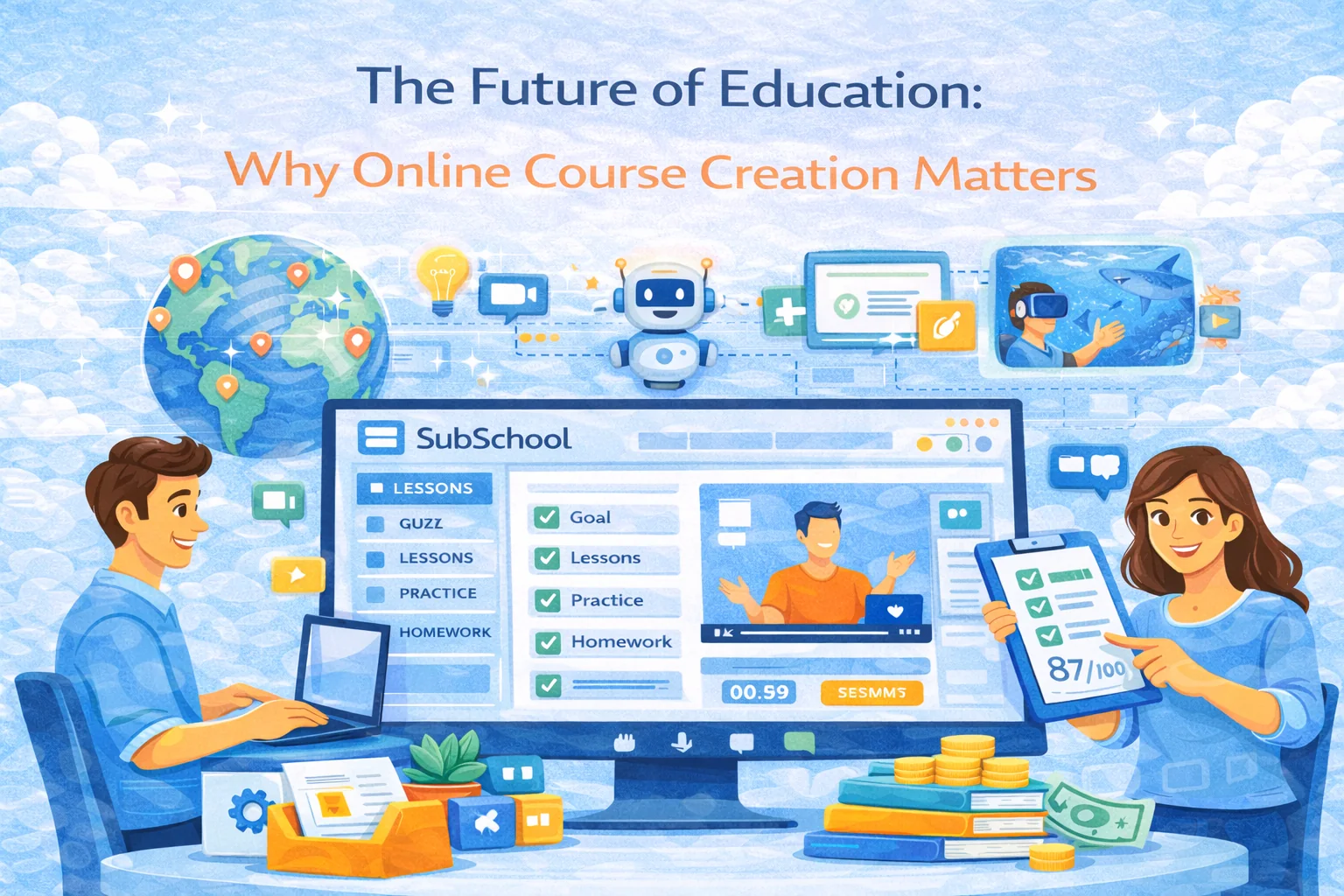
Platforms like SubSchool exist specifically to make the building + delivery part less painful — so educators spend time on teaching, not on duct-taping tools together.
4) Global reach (without turning you into a full-time marketer)
Traditional teaching is geographically capped.
Online course creation opens:
- students from other cities/countries
- niche audiences (small locally, huge globally)
- partnerships and referrals
- marketplace distribution (when you’re ready)
And you can still keep it simple: one course, one niche, one clear outcome.
A quick “real life” example
Say you teach math exam prep.
A strong online version looks like this:
- Entry diagnostic → identifies weak areas
- modules by topic (each with short lessons + practice)
- homework with clear feedback rules
- weekly live session for mistakes + strategies
- final exam simulation + score report
- optional 1:1 upsell for those who want coaching
That’s not “online education.” That’s a system.
The Future is Online
The future isn’t just “more courses.” It’s better learning systems.
Here’s what’s becoming standard in 2026:
1) AI-assisted learning (but not the gimmicky kind)
The value isn’t “AI wrote a lesson.” The value is:
- faster creation of drafts, quizzes, and variants
- personalization (different practice sets for different levels)
- smarter feedback loops
- easier adaptation for different student needs
Educators who use AI as a production line, not as a magic wand, will ship more high-quality content.
2) Assessment is becoming the product
Learners want proof.
Courses that win often include:
- diagnostics (start point)
- checkpoints (progress)
- final assessment (outcome)
- portfolio artifacts (something to show)
Even in soft skills: essays, scenarios, interviews, case tasks.
3) Micro-learning + mobile-first is non-negotiable
Students consume learning in small windows.
Courses that respect attention win:
- shorter lessons
- clear next steps
- “one concept → one practice”
- fast navigation and progress visibility
4) The educator becomes a brand (even if they hate that idea)
You don’t need to be an influencer. But learners choose people they trust.
Trust comes from:
- clear positioning (“I help X achieve Y”)
- visible outcomes and examples
- consistent voice
- clarity over hype
Online course creation makes this easier because your teaching becomes visible at scale.
What Educators Should Do Now (Practical, Not Inspirational)
If you’re an educator reading this and thinking “okay, but where do I start?” — here’s the clean path:
- Pick one outcome: pass exam / learn skill / improve grade / get job
- Build a course skeleton: modules → lessons → practice → assessment
- Create one “prototype module” first (don’t build 40 lessons blind)
- Add a diagnostic + a final checkpoint (instant perceived value boost)
- Use live sessions only where they matter (feedback, Q&A, coaching)
- Publish, collect feedback, iterate
- Only then scale content volume
And use a platform that doesn’t force you to assemble a Frankenstein stack of video hosting + payments + homework + tracking + communication. That’s the whole reason platforms like SubSchool exist.
Conclusion
Education is heading online because the world is heading online — but that’s the boring part.
The important part is this: online course creation turns teaching into a structured, scalable learning experience. It lets educators deliver better outcomes, reach more learners, and build something that grows without requiring them to clone themselves.
If you embrace online course creation now — with structure, good assessments, and a real feedback loop — you’re not “following a trend.” You’re building the default format of education for the next decade.