How to Create a TOEFL Online Course (that matches the 2026 TOEFL iBT)
If you build a TOEFL course like it’s still 2022, your students will feel it on test day. As of January 21, 2026, TOEFL iBT has new task types and a new 1–6 scoring scale.
This guide shows how to turn that reality into a course structure that:
- fits adult schedules,
- produces measurable score gains,
- and is easy to deliver (and sell) on SubSchool.
1) Start with the rules of the game (TOEFL iBT 2026 essentials)
New structure (tasks + time)
ETS lists the TOEFL iBT sections, task types, and base timing like this (about 2 hours total; adaptive so it can vary):
- Reading (≈30 min): Complete the Words, Read in Daily Life, Read an Academic Passage
- Listening (≈29 min): Listen and Choose a Response, Conversation, Announcement, Academic Talk
- Writing (≈23 min): Build a Sentence, Write an Email, Write for an Academic Discussion
- Speaking (≈8 min): Listen and Repeat, Take an Interview
New scoring (and the annoying transition period)
TOEFL score reports now use a 1–6 scale in half-point increments. The overall score is the average of the 4 sections, rounded to the nearest half band.
For a two-year transition after Jan 2026, students also get a comparable overall 0–120 score.
Course implication: you can’t market “get 100+” as the only framing anymore. You need two progress dashboards:
- “Band target” (e.g., 4.5 / 5.0 / 5.5),
- plus “legacy equivalent” for schools still asking 0–120.
2) Define your promise by score band + timeline
Don’t sell “TOEFL prep.” Sell a plan:
Examples:
- “From 3.5 → 4.5 in 6 weeks (45 min/day)”
- “From 4.5 → 5.5 in 4 weeks (intensive)”
- “Home Edition readiness + score gain: pass the equipment check + raise band by 0.5”
ETS even provides a comparison table mapping 1–6 bands to old section/total ranges.
Use it to set realistic targets and avoid promising fairy dust.
3) Build the curriculum around tasks (not “skills” in the abstract)
Most courses are “Reading strategies, Listening strategies…” and then students freeze when the task looks different.
Instead: each module = one task type from the official TOEFL structure.
Example curriculum map (simple and complete)
Reading
- Complete the Words
- Read in Daily Life
- Read an Academic Passage
Listening
4) Choose a Response
5) Conversation
6) Announcement
7) Academic Talk
Writing
8) Build a Sentence
9) Write an Email
10) Academic Discussion Post
Speaking
11) Listen and Repeat
12) Take an Interview
Each module gets:
- task explanation + traps,
- timed reps,
- review loop,
- checkpoint test.
4) Use a weekly engine that forces improvement
Here’s the loop that works for TOEFL (and doesn’t require motivation as a personality trait):
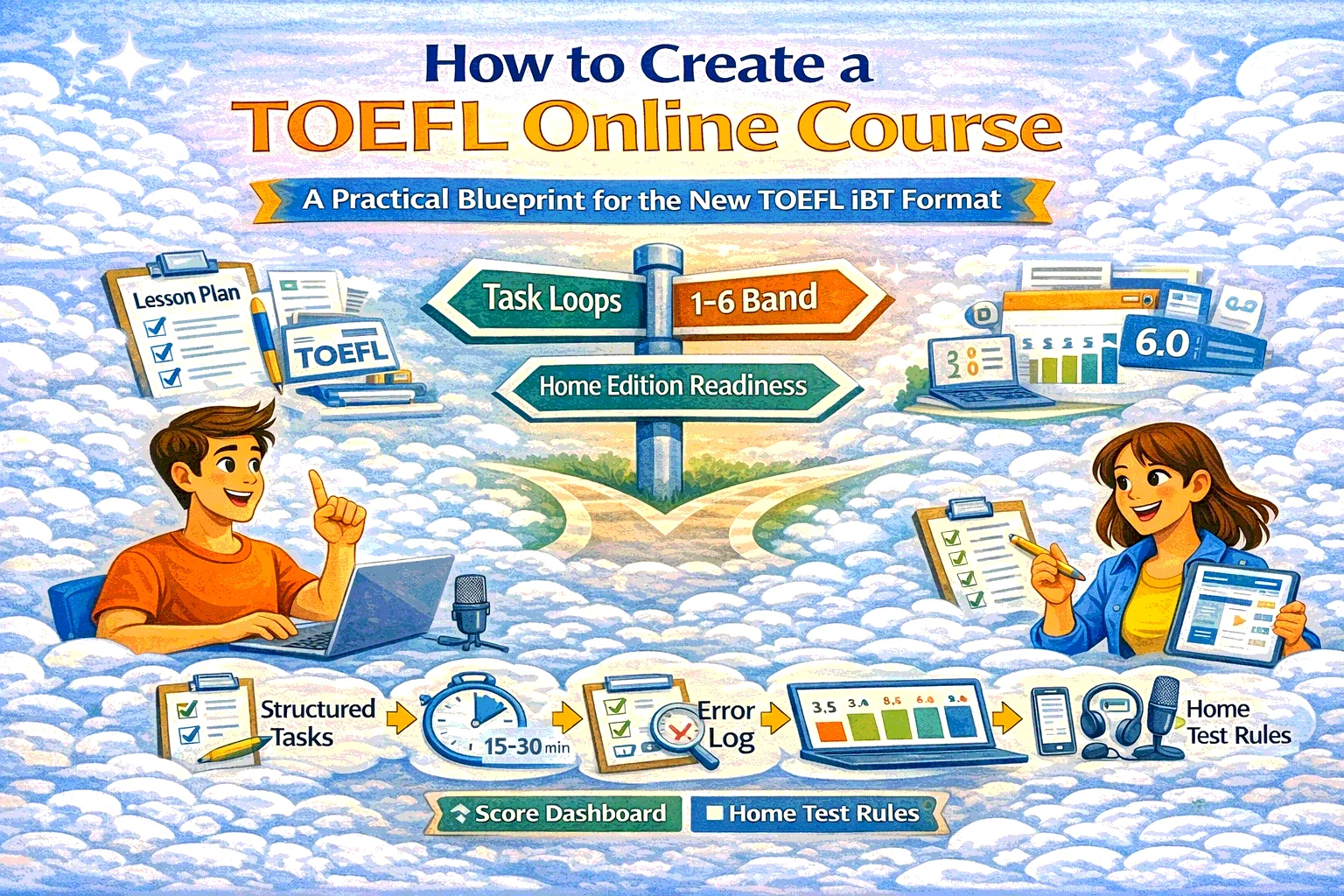
Weekly loop
- Diagnose (one short timed set per task)
- Fix (micro-lessons for top 2 mistakes)
- Drill (reps with strict timing)
- Simulate (mixed task set)
- Review (error log + “one rule per mistake”)
Non-negotiable: error log. If your course doesn’t force reflection, students repeat the same mistakes forever (and call it “practice”).
5) Design homework for adults (short, targeted, inevitable)
Homework rule: 20–30 minutes max, otherwise completion collapses.
A good daily pack:
- 1 timed mini set (5–10 mins)
- 1 correction + rewrite (10 mins)
- 1 speaking/writing response (5–10 mins)
This becomes very easy to run on SubSchool:
6) Make “Home Edition readiness” a dedicated module (huge trust boost)
Students fail TOEFL Home Edition not only by English — they fail by setup.
ETS is strict: if they don’t meet requirements on test day, they may lose the attempt with no refund/reschedule.
What your course should explicitly teach (with a checklist)
From ETS at-home requirements:
- Desktop/laptop only (no tablet/phone)
- One monitor only (no dual screens)
- No headsets/earphones
- Webcam must show room; proctor may require 360° view
- May need a second camera (phone/tablet) in some cases
- No paper notes; only small whiteboard or sheet protector + erasable marker
- Must be alone; no one enters the room
Course deliverable: a “48-hour readiness” checklist + a “test day rehearsal” routine.
This is also an easy upsell: Home Edition Setup + Mock Check-in.
7) Delivery: how to run this course on SubSchool
Three practical setups:
Option A — Upload your videos → ship fast
Upload your TOEFL lesson videos in a batch and assemble the course quickly in SubSchool. Great if you already have content.
Option B — Text + short videos + AI homework
Build short lessons (text-first is fine). Then use SubSchool to generate homework aligned to each task module.
Option C — Speaking & Interview practice as “video tasks”
TOEFL speaking now includes interview-style performance.
You can mirror that using SubSchool interview-format tasks (originally meant for EduHire) so students submit timed video responses that you (or a rubric) can score.
8) Pricing that doesn’t scare TOEFL students away
TOEFL buyers are skeptical (they’ve been burned by “guaranteed 110+” nonsense).
Use a clean ladder:
- Try 1 lesson (one task module + feedback rubric)
- 4-week task bootcamp (most popular)
- 8–10 week full plan (all tasks + Home Edition readiness)
- Add-on: Home Edition setup rehearsal
And yes: letting students buy a single lesson first is a nice trust lever on SubSchool.
9) Quality checklist (before you publish)
Your TOEFL course is ready when:
- ✅ It’s structured by official task types (not vague “skills”).
- ✅ It includes timed practice every week (not “do exercises anytime”)
- ✅ It teaches 1–6 band progress clearly.
- ✅ It has a dedicated Home Edition readiness module with rules + rehearsal.
- ✅ Every speaking/writing module has a rubric students can understand in 10 seconds.