
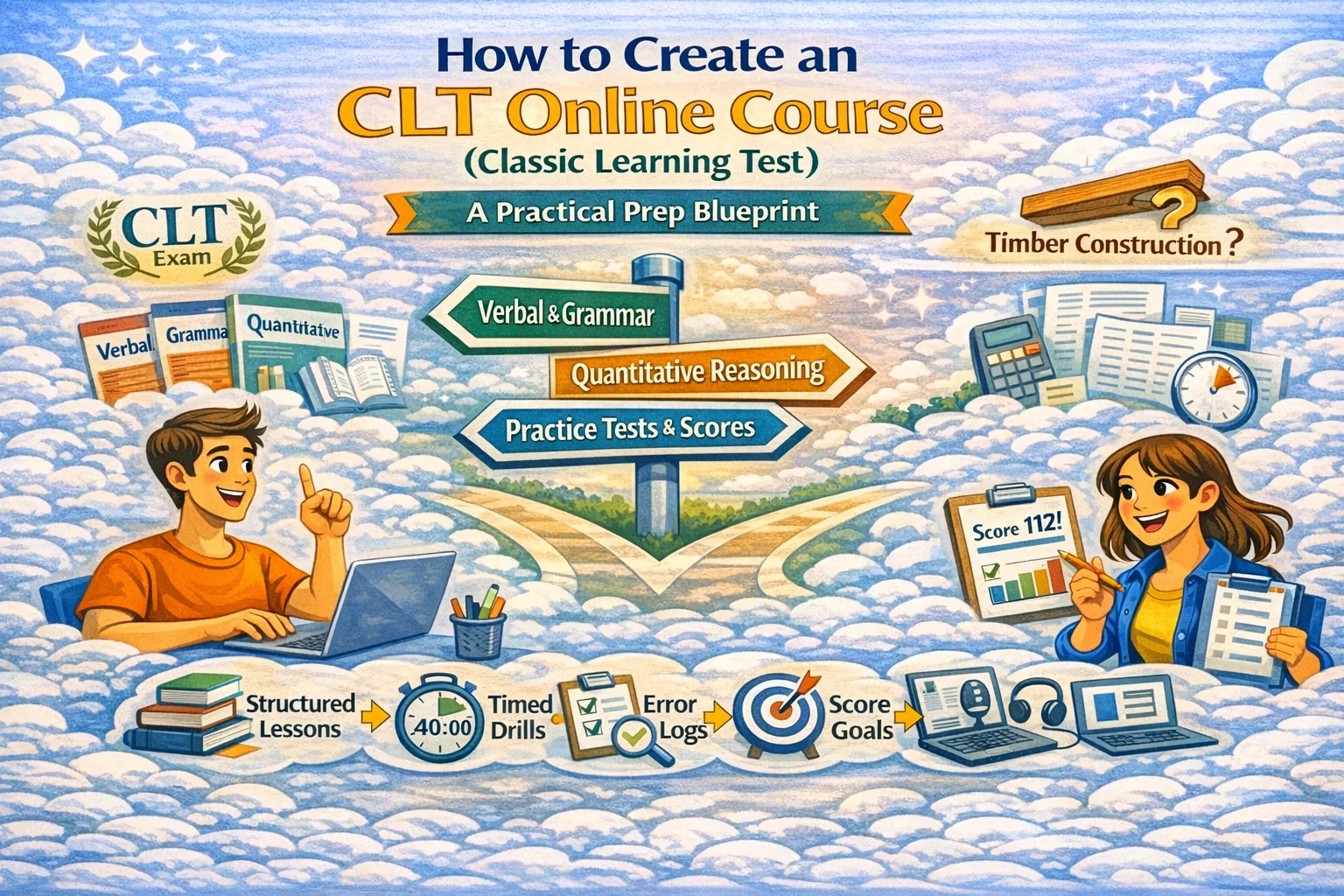
How to Create a CLT Online Course (Classic Learning Test)
Quick sanity check before we build anything: “CLT” can mean two totally different things:
- Classic Learning Test (CLT) — a college entrance exam.
- Cross-Laminated Timber (CLT) — construction/engineering materials.
This guide is about the Classic Learning Test (the exam). If someone googles “CLT course” and lands on your page, this one sentence saves confusion and keeps SEO clean.
1) Understand what you’re preparing students for (formats + timing)
CLT isn’t “one test.” It’s a suite:
- CLT (typically grades 11–12) — college entrance exam comparable to SAT/ACT.
- CLT10 (grades 9–10) — college-prep version with its own dates.
- CLT3–8 (grades 3–8) — diagnostic/summative growth tests.
Remote vs in-school matters (because the test can differ)
If your students take the remotely proctored CLT, the official guidance shows:
- 3 sections, 40 questions each
- Verbal Reasoning: 40 min
- Grammar/Writing: 35 min
- Quantitative Reasoning: 45 min
- No essay section
- No real breaks (only optional 1-minute stretch between sections).
But CLT also has versions where an optional essay can exist (e.g., CLT10 or in-school CLT in some cases).
Course implication: you’re not building “English + math.” You’re building performance under strict time caps, and you should clearly label which delivery path your course targets (remote / in-school).
2) Pick your course promise (and avoid the “vague tutoring” trap)
A good CLT course promise is specific + measurable:
Examples:
- “Raise Verbal + Grammar by 6–10 points in 6 weeks (3–4 hrs/week).”
- “Remote-ready CLT: pacing + accuracy + proctor simulation.”
- “CLT10 foundation course for 9th–10th graders: skills + confidence + first benchmark.”
To keep your marketing honest, anchor it to the official score model:
- Overall scale 0–120
- Section scores are scaled 0–40 each.
So we can talk about progress like: “+5 in Verbal” instead of hand-wavy “better at reading.”
3) Build the curriculum around the sections (not random topics)
Your course should mirror the test’s structure. For the common remotely proctored flow:
Module A — Verbal Reasoning (40 min)
What you teach:
- Passage strategy: skim structure → locate claim → eliminate distractors
- Vocabulary-in-context
- “Argument logic” basics (what must be true, what weakens/strengthens)
Practice design (the part students pay for):
- 10–12 minute timed micro-sets (accuracy + speed)
- “Wrong-answer taxonomy”: why each wrong choice looked tempting
- Weekly mixed set under exact timing
Module B — Grammar/Writing (35 min)
What you teach:
- Sentence mechanics that actually show up in standardized tests (agreement, modifiers, parallelism, punctuation)
- Editing strategy: fastest wins first (obvious errors), then deeper fixes
Practice design:
- Daily 15-minute “error sprint”
- One weekly timed section + rewrite (students must correct and explain)
Module C — Quantitative Reasoning (45 min)
What you teach:
- Setup recognition (turn word problems into equations fast)
- Estimation and “sanity checks” to kill traps
- Time strategy (when to skip, when to commit)
Practice design:
- Speed drills (2–3 minutes per cluster) + one longer timed set weekly
- Mistake log by type: concept / setup / algebra slip / time panic
Optional Module D — Essay (only if your audience needs it)
Don’t assume essay is always part of the student’s test mode. For some paths it’s optional, and for remote proctoring it’s explicitly not included.
If you include essay training, sell it as an add-on.
4) The weekly loop that makes scores move
Here’s a loop that works because it’s brutally simple:
- Timed set (one section)
- Review using an error log (what happened + why)
- Patch lesson (short, targeted)
- Re-test the same weakness within 48 hours
If your course doesn’t force a structured review, students will “practice” forever and improve slowly.
5) Use official CLT materials the right way (and don’t invent randomness)
Two gold sources from CLT itself:
- Official CLT Student Guide (3rd Edition) includes multiple full-length practice tests + explanations.
- CLT’s own notes confirm practice exams can be timed like the real thing (including the 40/35/45 section timing).
Course implication: build your diagnostics and checkpoints around official-style timing, then “teach the why” in between.
6) Package + sell it cleanly in SubSchool
Three practical ways to ship:
Option 1 — You already have videos (fastest)
Upload your videos in bulk, structure them into modules, and publish the course on SubSchool. No “build a website,” no duct-taped tools.
Option 2 — You teach via text + short clips (most scalable)
Write clear lessons (short, tactical), and let SubSchool generate homework from lesson context so you’re not manually writing 300 exercises.
Option 3 — “Section Sprints” (best conversion)
Sell separately:
- Verbal Sprint (2 weeks)
- Grammar Sprint (2 weeks)
- Quant Sprint (2 weeks)
- Then a bundled “Full CLT Bootcamp.”
This also matches how students buy: they usually feel weak in one section first.
Bonus: the marketplace flow lets students buy a single lesson before committing (trust builder).
7) What to call the course (SEO + clarity)
Names that work:
- “CLT Online Prep Course (Remote-Proctored Ready)”
- “CLT10 Prep Course for 9th–10th Grade”
- “Classic Learning Test Bootcamp: Verbal + Grammar + Quant”
Avoid:
- “CLT course” alone (hello, timber engineers).