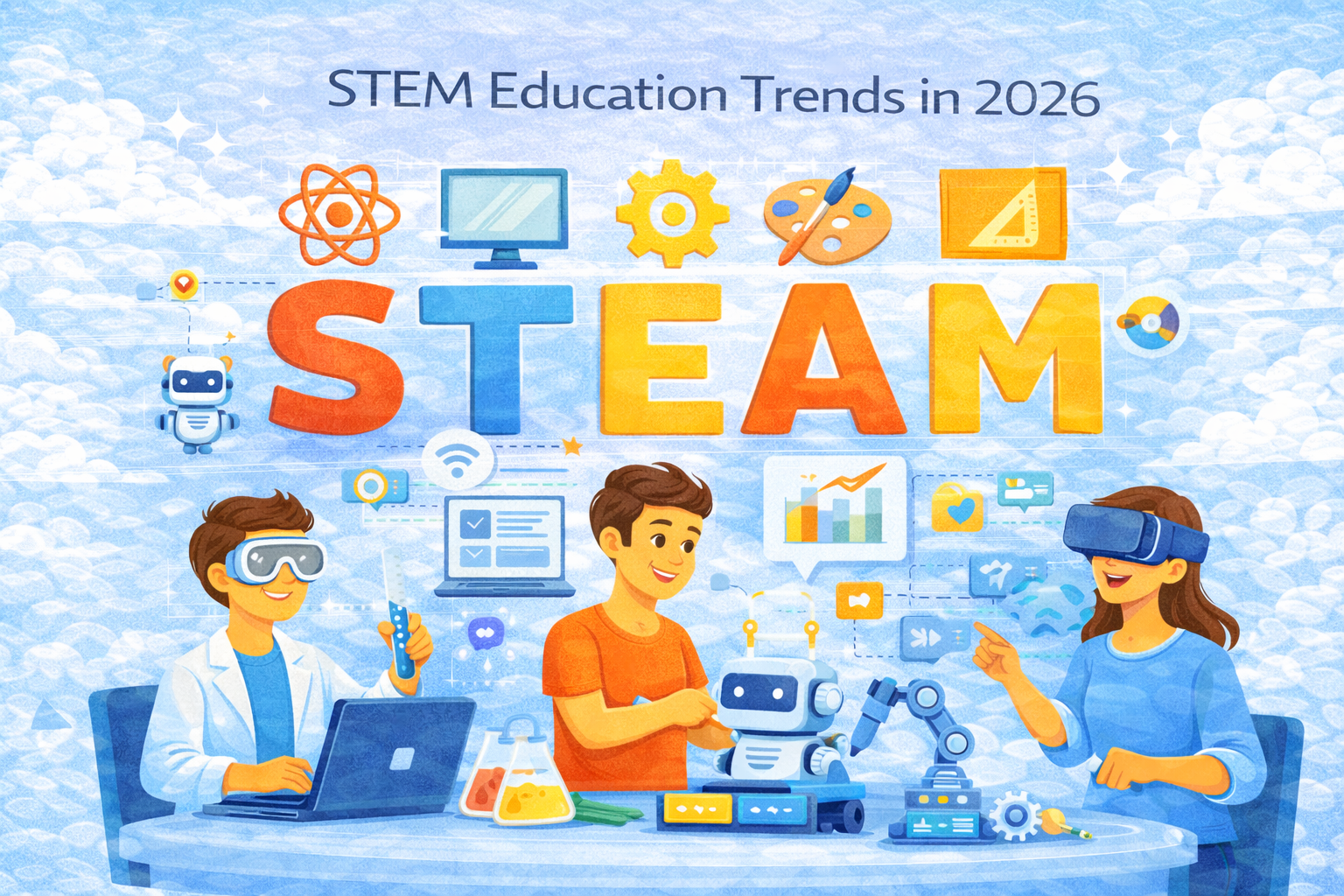
STEM Education Trends in 2026 (and how to actually use them in your classroom)
STEM education isn’t “the future” anymore — it’s the default expectation. In 2026, the gap is no longer “Do you teach STEM?” but “Do you teach STEM in a way that feels real, modern, and relevant?”
Below are the biggest STEM/STEAM trends educators are leaning into right now — plus practical examples you can copy, tools that help, and the traps that make “innovative” lessons flop.
1) Integration of technology (now: AI + data + real workflows)
In 2023 this meant “let’s use tablets” or “add coding.”
In 2026 it’s more like: use the same tools people use outside school — and teach students to think, test, and explain.
What this looks like in practice
- AI-assisted learning (with guardrails): students use AI to brainstorm hypotheses, check reasoning, generate practice questions — then must justify answers and show work.
- Data literacy everywhere: students collect data (even simple classroom surveys), clean it, visualize it, and explain conclusions.
- Computational thinking across subjects: not only in coding class — also in biology (classification), physics (models), and even art (generative patterns).
Classroom ideas you can steal
- “AI as lab assistant”: students ask AI for three possible explanations for an experiment outcome, then test which one is plausible with evidence.
- “Mini data project”: students measure plant growth, track it weekly, chart it, and write a short report (“claim → evidence → reasoning”).
- “Code isn’t the goal”: use block-based or simple scripting to model a phenomenon (like predator/prey or motion), then discuss assumptions.
How SubSchool fits
If you’re building STEM courses online (or hybrid), the killer move is turning “cool tech” into repeatable learning loops: lesson → practice → feedback → exam. Use course structure + homework + exams to make tech skills measurable, not “fun but vague.”
2) Focus on hands-on learning (project-based or it didn’t happen)
STEM is learned with hands, not with slides. In 2026, hands-on doesn’t mean “buy expensive kits.” It means make students build, test, fail, and improve.
Hands-on formats that work even on a budget
- Maker challenges: build a bridge from paper; optimize for strength/weight.
- Robotics-lite: no robot? Do “human robot” logic lessons, then move to simulators.
- Home labs: safe experiments with household materials + clear constraints.
A simple project template (works for any STEM topic)
- Problem: “Design X to do Y under constraints.”
- Hypothesis: “If we change ___, then ___ happens.”
- Build/test: short cycles (10–15 minutes).
- Data: track results (even basic tables).
- Reflection: what failed and why.
- Iteration: revise and test again.
Pro tip: the real learning isn’t the final build — it’s the iteration notes. Reward that.
3) Collaboration between schools and industry (career pathways, not guest lectures)
The trend is shifting from “invite a speaker once” to build long-term exposure:
- real problems,
- real feedback,
- portfolio outcomes students can show.
What “industry collaboration” can look like
- Micro-briefs from local companies: “We need a simple prototype / poster / data dashboard.”
- Mentor feedback on student presentations (15 minutes, recorded).
- Career simulation: students role-play engineers, analysts, QA testers.
A lightweight model that doesn’t kill your schedule
- Month 1: intro project + skills
- Month 2: industry brief + build
- Month 3: showcase + reflection + portfolio
If you want to scale this beyond one classroom, you’ll need a clean system to manage submissions, grading criteria, and progress tracking — otherwise it becomes chaos wearing a blazer.
4) Increased emphasis on STEAM (the “A” is where breakthroughs hide)
STEAM isn’t “make it pretty.” It’s:
- design thinking,
- storytelling,
- visualization,
- creativity under constraints.
In 2026, STEAM is how you make STEM understandable and shareable.
STEAM examples that improve STEM outcomes
- Students must create a one-minute explainer video for a concept (forces, circuits, ecosystems).
- Students redesign a product for accessibility (ergonomics + constraints).
- Students present results as an infographic (forces clarity, not fluff).
Why it matters
When students can communicate technical work, they actually understand it. Also: parents and admins love it because the results are visible.
5) Personalized learning (not “different worksheets,” but adaptive pathways)
Personalized learning has matured: it’s less “everybody does their own thing” and more smart differentiation with clear standards.
What works
- Core lesson for everyone → then branching practice:
- Support track: guided practice, hints, examples
- Standard track: normal problem sets
- Challenge track: extensions, open-ended tasks, deeper reasoning
- Fast feedback loops: small checks after each lesson
- Clear mastery criteria: students know exactly what “good” looks like
How to keep it fair
Personalized ≠ easier. It means different routes to the same learning goal.
Where SubSchool helps
Personalization becomes real when:
- assignments are structured,
- homework is trackable,
- exams show improvement over time,
- you can measure entry level → exit level growth (that’s what parents and school leadership actually care about).
6) Assessment is evolving (more performance, less memorization)
In STEM, modern assessment is shifting toward:
- projects and portfolios
- open-ended reasoning
- oral explanations
- lab-style evidence
- applied problem solving
Better assessment formats
- “Explain your answer” short responses
- Mini-labs with data interpretation
- Design tasks with rubrics
- Oral interviews (“walk me through your thinking”)
The key trend: assessment is becoming more like real work, less like trivia.
7) Equity and accessibility (design for the real classroom)
The digital divide didn’t disappear — it just got more annoying.
2026 best practices
- Mobile-first access (a lot of students rely on phones)
- Low-bandwidth options (PDFs, compressed video, transcripts)
- Captions and readable formatting
- Clear structure so students don’t get lost
Accessibility isn’t charity — it’s how you prevent half the class from silently failing.
Common mistakes (that make STEM “innovative” but ineffective)
- Too much tech, not enough learning goal
- Projects with no rubric (“cool builds” with random grading)
- No iteration cycle (students build once, fail once, give up)
- No reflection (they can’t explain what happened)
- Assessment doesn’t match the lesson (teach hands-on, test memorization)
If you fix only one thing: align objectives → activities → assessment.
Conclusion: 2026 STEM is about real skills, measurable progress, and repeatable systems
The biggest STEM trend isn’t one tool — it’s the shift toward authentic learning:
- building things,
- analyzing data,
- communicating clearly,
- improving through feedback.
If you want STEM to scale beyond a single inspired teacher, you need structure: course flow, homework, exams, tracking, and feedback loops. That’s exactly the type of workflow educators can organize cleanly in platforms like SubSchool — without turning their life into 47 spreadsheets and 12 WhatsApp chats.